In Old Riga, there are places where the camera returns again and again. Especially during the Christmas season, when lights, decorations, and historical facades become part of the festive story. In recent weeks, one building has come into focus, becoming the backdrop for the Christmas atmosphere not only in Latvia but also beyond its borders – while Forbes magazine recognized Old Riga as one of the most attractive Christmas tourist destinations this season, reports the program "900 Seconds" (TV3).
From scenes of the Latvian winter cinematic classic "Christmas Mayhem" (Ziemassvētku jampadracis) to the music video for the new Christmas song by global pop star Kylie Minogue, which has already been viewed by millions.
The light of cameras and spotlights seems to have long become a familiar sight for this building and its facade. However, its true history and legacy are known only to a few.
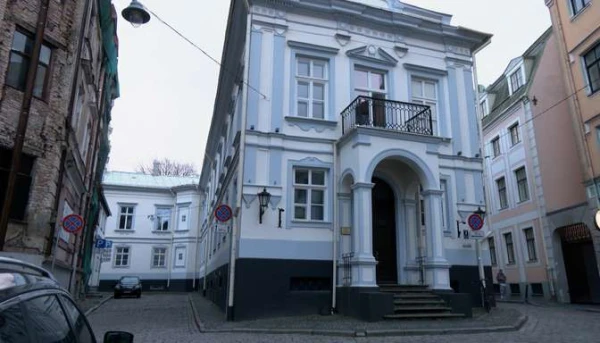
The building on Maza Pils Street began its history in the 19th century. During the time of Tsarist Russia, it served as the residence and center of the Orthodox bishop – at a time when the nearby Church of St. Mary Magdalene was an Orthodox temple. After World War I, the building was once again transferred to the Catholic Church, and during the period of independent Latvia, it housed the residence and curia of the Archbishop-Metropolitan of the Riga Catholic Archdiocese.
"Of course, during the Soviet era, nationalization occurred, and most of this building came under state control, into the ownership of the Soviet authorities. Only two apartments were left on the first floor, where the rector of the parish of Mary Magdalene and the rector of St. James Cathedral in Riga lived. Everything else was occupied by various institutions of the Soviet authorities. And already in the 1990s, after the restoration of Latvia's independence, this building was once again transferred to the Catholic Church," said Renars Birkovs, administrator of the St. James Catholic Parish in Riga.
The architecture of the building is restrained yet impressive – an example of neoclassicism, built and reconstructed in the early 20th century.
"In the early 20th century, the building was constructed by a German architect – at that time, there were both German and Latvian architects in Riga. The Catholics commissioned the project from German architects. Today, there is a Sunday school here, meaning correct, official, ceremonial premises. And the facade of the building is so substantial that it resembles something very serious," clarified Janis Leinieks, editor-in-chief of the magazine Latvijas Arhitektūra.
Like Old Riga itself, this building is alive. The interior spaces are gradually being restored, occasionally revealing historical cultural layers. On weekdays, children and adults engage in activities here, rehearsals of the vocal ensemble "Dzeguzīte" take place, as well as meetings and events.
"Being in such a place, where the presidential palace, the Saeima, and the very heart of Old Riga are nearby, of course, is a great joy that we can be here," noted Birkovs.
If you walk from the square by the Presidential Palace to Maza Pils Street, a small nameless square opens up – a conscious expansion of urban space that has recently gained new recognition.
"Maza Pils Street is such an expansion, a very elegant composition in Old Riga, where the narrow becomes wider, and the wide becomes narrower. This difference between large and small streets and squares is one of the features of Old Riga," added Leinieks.
Maza Pils Street itself also has its own history. It emerged in the 13th century as a path from the city to the Monastery of the Holy Spirit. Over its 190 meters, this street has absorbed entire layers of epochs – amidst ancient walls coexist the Catholic Church of St. Mary Magdalene and St. James Cathedral. A place where everyday life, history, and cinema converge in one frame.