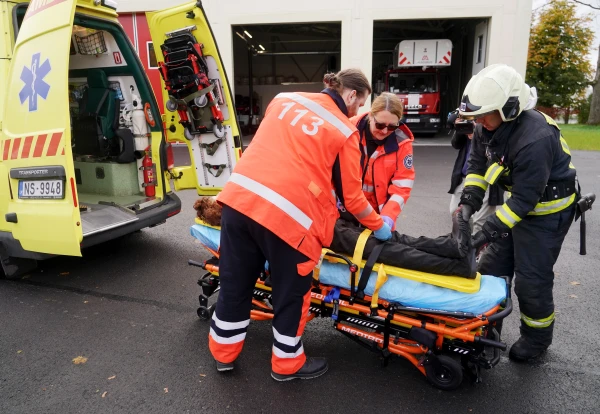
The Saeima of Latvia approved the pension reform for length of service: it adopted amendments to nine laws that regulate gradual changes in the pension system starting from 2027.
The main reason for the reform is the desire to save costs. Now medical emergency workers, police officers, military personnel, and cultural workers are facing significant changes. And not just them. However, there is a transitional period.
Emergency Medical Workers
For emergency medical workers, pensions for length of service have been retained. They can receive it if:
-
they are 55 years old;
-
have 25 years of work experience, of which at least 10 of the last years are in emergency services.
-
work in other institutions, including commercial ones, will be included in the work experience, but with a limitation: work in such institutions must amount to at least 160 hours per month, and no more than 20% of the total work experience.
What Has Changed
Currently, the pension for length of service is still available at the same age of 55, but with 20 years of service, of which the last five must be in emergency services.
Previously, any emergency worker could retire due to health deterioration regardless of age (if their service was at least 20 years), and they were forced to leave service after the conclusion of the State Commission for Medical Expertise of Health and Disability. Now the service must be at least 25 years, and a decision from a council of a medical center specializing in occupational diseases and radiation is required.
New Calculations
The pension will be calculated based on the average salary for the last 120 months of work (that is, for 10 years), excluding the last 2 months before leaving service.
Employees who are 55 years old with 25 years of experience will receive a pension of 45% of the average salary for the last 120 months (minus two months).
For each year of service above 25 years, an additional 2% of the average salary will be added (that is, 26 years of service - 47%, and so on).
Employees who leave service due to health reasons (with confirmation from the council) will receive a pension of 35% of the average salary. For each year of work beyond the 25-year service, an additional 2% of the average salary will be added.
The maximum pension amount cannot exceed 70% of the average salary in any case and cannot be lower than the amount of social benefits.
For employees who, as of January 1, 2027, have less than 15 years of service, the required age for retirement will increase annually:
from January 1, 2027 — 20 years and 6 months,
from January 1, 2028 — 21 years,
from January 1, 2029 — 21 years and 6 months, and so on.
Those who, as of January 1, 2027, have less than 10 years of service will retire under the new rules.
Police Officers and Border Guards
Conditions for employees of the internal affairs system with ranks are also being tightened:
-
the right to a pension for length of service is only for those who have worked in the Ministry of Internal Affairs for at least 12 years and 6 months;
-
service of at least 25 years;
-
age - after 55 years;
-
health condition or staff reductions (with 20 years of service).
An exception is only for those positions that cannot be held after 50 years (due to duties). Employees in these positions will be able to request a pension with 25 years of service.
What Has Changed
From now on, years of work in other organizations, including commercial ones, will also be included in the service, provided that they do not exceed 20% of the total length of service.
Until now, employees whose service in the Ministry of Internal Affairs exceeded 12 years and six months were granted a pension for length of service at 40% of their salary, and for each year of service beyond 12 years and six months, it increased by 1.5% of the average salary for the last five years.
The law also reduces the maximum pension limit. Currently, it is 80% of the average salary for the last five years; it will be 70% of the average salary for the last 120 months minus the last two.
New Calculations
The pension will be calculated based on the average salary for the last 120 months of work, excluding the last 2 months before leaving service. (Previously - based on the average salary for the last five years).
The pension amount is 45% of the average salary for the last 120 months with 25 years of service. Each year exceeding 25 years adds another 2% to the pension.
The pension for employees who retire due to health reasons will be 35% of the average salary with 25 years of service (+2% for each subsequent year).
For those whose right to a pension for length of service arises before December 31, 2026, everything will be calculated according to the rules that apply until December 31, 2026. For others, the retirement age for length of service will increase from 50 to 55 years. The service requirement will increase from 20 to 25 years.
Military Personnel
Currently, military personnel are entitled to a pension for length of service if they have 20 years of service, of which at least 15 are in the armed forces, but it will be 25 years of service, of which at least 20 are in the armed forces.
The pension for length of service will be calculated based on the average salary for the last 120 months, not the last 5 years as before.
The pension for 25 years of service will be 35% of the salary (plus 2% for each year exceeding 25 years). If a serviceman is discharged due to health reasons or reorganization, the pension is calculated at 45% of the salary.
At the time of retirement due to age — prematurely or at 65 years — the former military personnel loses the right to a pension for length of service.
A separate law stipulates a gradual increase in the maximum age for military service — depending on ranks and whether a person is on active duty or in reserve.
Cultural Workers: Who Is Entitled to "Temporary Pensions"
According to the new edition, the right to a pension for length of service is granted to:
-
ballet artists - at 38 years and after 18 years of service;
-
solo vocalists and circus performers - at 45 years and after 20 years of work;
-
orchestra musicians, choir members, and puppet theater actors - at 50 years and after 25 years of service;
-
drama theater actors - at 58 years and after 35 years of service.
Important!
The amendments introduce a new concept: a temporary 5-year pension for length of service, which is paid during retraining if the employer confirms a significant violation or loss of professional ability.
The right to a "temporary" pension will be granted to:
-
ballet and circus performers who have worked in the profession for at least 11 years;
-
solo vocalists, orchestra musicians, choir members, and actors with at least 15 years of experience.
New Calculations
The pension for length of service for cultural workers will be calculated based on the average salary for the last 120 months (minus the last two months before leaving work). The pension amount will be 45% of the average salary, not 55% as before.
For those who acquire the right to a pension for length of service before December 31, 2026, it will be granted under the provisions in effect until December 31, 2025.
For those who, as of January 1, 2027, have more than 15 years of service, the pension will be calculated and paid according to the provisions of the current law (except for the pension calculation norm). Their pension will be calculated based on the average salary for the last 5 years minus two months before dismissal.
Significant changes will affect cultural workers who, as of January 1, 2027, have less than 15 years of service.
For them, the service and age requirements will increase as follows:
-
from January 1, 2027 - 30 years and 6 months of service, upon reaching the age of 55 years and 6 months;
-
from January 1, 2028 - 31 years of service at the age of 56;
-
from January 1, 2036 - 35 years of service at the age of 58.