
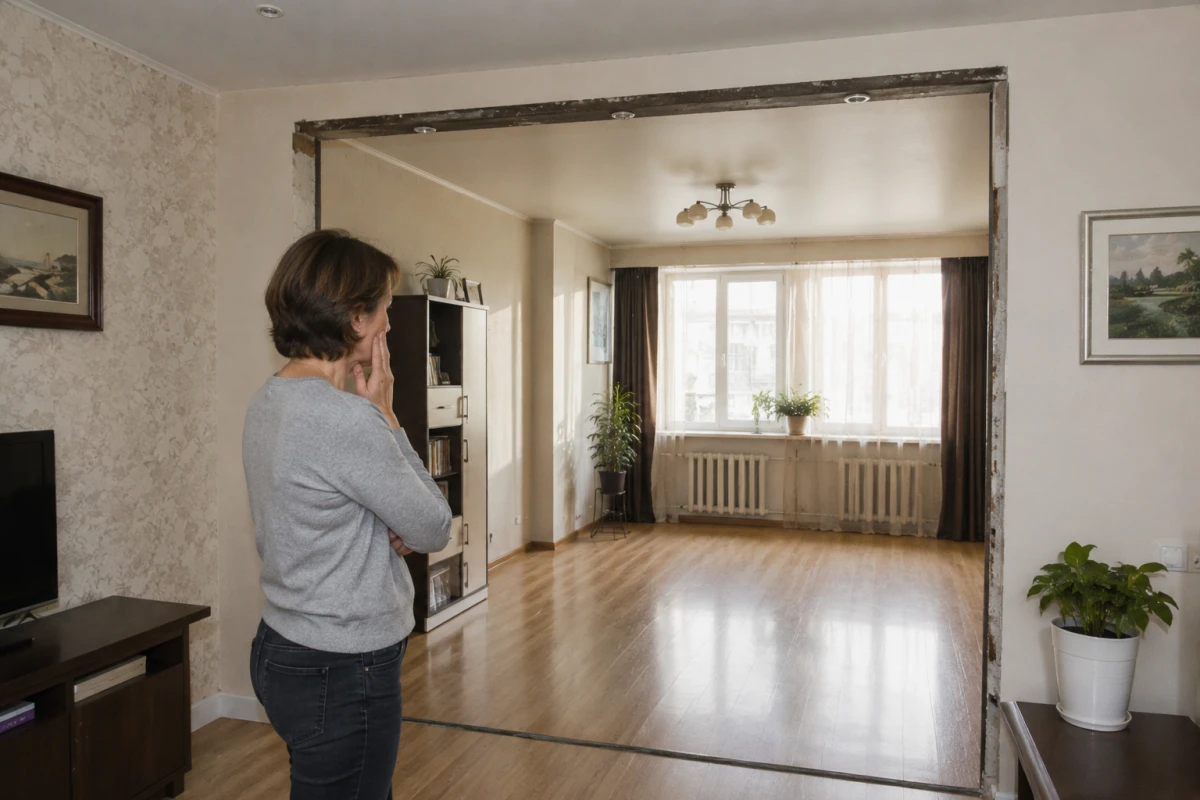
I am planning to purchase a one-room apartment converted into a studio. The owners did the alterations themselves: they simply demolished an internal wall that is not load-bearing, without coordinating with anyone.
Should I demand that they legalize this change before purchasing the apartment, or is it not essential? Or would it be easier and faster if I buy the studio as is and then approach the Building Authority myself to legalize these alterations? What difficulties might I encounter in the second case?
Sergey Makhnev, a representative of the Latvian Association of Lawyers, answers readers' questions on bb.lv:
– Demolishing a wall, even if it is not load-bearing, is still considered a reconfiguration (vienkāršota pārbūve). According to the law, such changes must be approved and reflected in the documentation. Therefore, buying an apartment 'as is' carries certain risks; in my opinion, it is not advisable to purchase it until the issue of reconfiguration is clarified in writing.
The problem lies not so much with the wall itself, but with the fact that after the purchase, the new owner assumes full responsibility for the acquired property (including any illegal reconfiguration carried out by previous owners). After the purchase, the argument 'the previous owner did this' no longer holds.
Therefore, it is in the buyer's interest to check before the transaction:
- whether the actual layout corresponds to the cadastral plan;
- whether there is an approved project in the Building Authority (Būvvalde);
- whether changes have been made to the Land Register and cadastral data;
- whether the reconfiguration has been officially documented.
To do this, one needs to request:
- the inventory case;
- the current apartment plan;
- information from the Building Authority about approvals;
- the technical passport/cadastral data.
Thus, if the apartment plan shows a separate kitchen and a separate room, but in reality, both represent an open space, then the reconfiguration is not legalized. This, in turn, entails the following risks:
- After the purchase, the new owner will have to pay for:
– measurements;
– creating a project/explanatory note;
– paying an architect or certified specialist;
– obtaining approval from the Building Authority;
– updating the cadastral data. - Various problems may arise: ventilation issues, changes to engineering communications, violations of fire safety requirements, etc. (especially relevant for older buildings). Consequently, additional projects and expertise may be required; in certain cases, there may even be a demand to restore the wall, returning the apartment to its original state.
- If the buyer is using a mortgage to purchase the apartment, it should be noted that banks and appraisers often check the compliance of the layout with the documents. In cases of discrepancies, various outcomes are possible, including a requirement to legalize the reconfiguration before the transaction. Or a complete denial of the mortgage.
- Upon subsequent sale, the same issues will arise with the new buyer.
Therefore, the optimal option is to require the seller to legalize the reconfiguration before the transaction. Alternatively, if this is not possible for some reason, at least obtain written confirmation from the Building Authority that such reconfiguration can be legalized.
As an option: invite a certified specialist who can analyze the situation considering specific nuances. This includes estimating possible additional costs related to the approvals. And then, based on the conclusion, negotiate with the seller for an appropriate discount. Such steps significantly reduce the risk for the buyer.













Leave a comment