
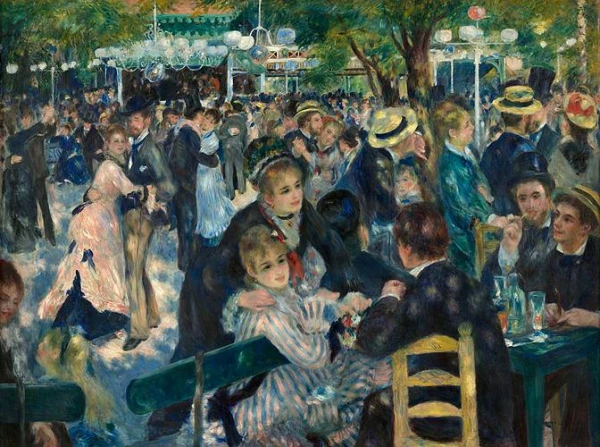
Due to the large number of works by the artist, he was accused for some time of having them created by assistants rather than personally.
The artist of happiness - this is how Auguste Renoir was called for his bright and joyful paintings.
Spring is the perfect time to visit the Orsay Museum for the exhibition "Renoir and Love, Happy Modernity."
.jpg)
For the first time since 1985 — the date of the last major retrospective of Renoir in Paris — the exhibition brings together about fifty paintings from the first part of his career, his greatest masterpieces. The exhibition explores the feeling of love in the broadest sense in the artist's work.
.jpg)
After a stroke in 1912, despite two surgeries, Renoir (1841-1919) was confined to a wheelchair, yet he continued to paint with a brush that was placed between his fingers by a caregiver. Family members also assisted him at the easel. The description of his working methods in the late period was left in his monograph by the artist Albert André, who was close to Renoir: "I was consistently astonished and amazed by the dexterity and confidence of the movements of his mutilated hand... He can no longer quickly change brushes. Once the necessary one is chosen and placed in his paralyzed fingers, it moves from the canvas to a cup of water — the washed brush is then returned to the palette, he picks up paint, and goes back to the canvas. When his hand becomes numb from the effort, someone must remove the brush from his fingers — he cannot spread them himself. Additionally, he needs cigarettes handed to him and his wheelchair moved; he squints one eye and grumbles if dissatisfied, and sometimes gives himself a scolding before returning to work." Due to the large number of works, Renoir was accused for some time of having them created by assistants rather than personally. However, this is refuted by the memories of contemporaries and several documentaries (for example, a segment from the film by Sacha Guitry "Ours"), which captured how he worked.
Since 1890, Renoir's wife was Aline Charigot. Their sons are the famous film director and writer Jean Renoir (1894—1979), and theater and film actor Pierre Renoir (1885—1952). The third son — Claude "Coco" Renoir (1901—1969) — was a film director and ceramic artist, not to be confused with his grandson Claude Renoir, a film producer. Pierre-Auguste's brother — Edmond Renoir (1848—1944) — was a well-known French journalist.
This exhibition is organized in collaboration with the National Gallery in London and the Museum of Fine Arts in Boston. The painting "Luncheon of the Boating Party" is exceptionally provided by the Phillips Collection in Washington; "The Promenade" by the J. Paul Getty Museum in Los Angeles, and "The Frog Pond" by the National Museum of Sweden.
The exhibition opened this week and will run until July 19.








Leave a comment