
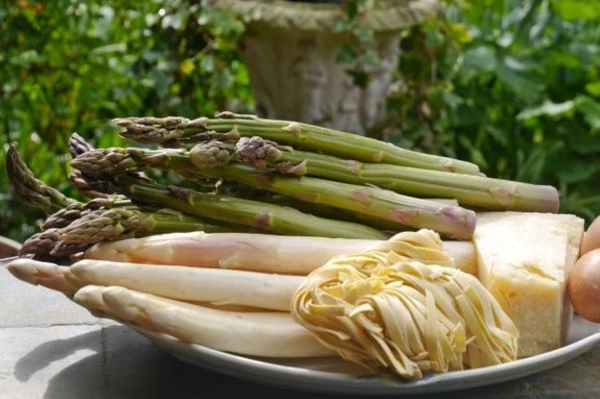
Special attention is paid to the selection of Spargelkönigin — 'Asparagus Queen.'
Spring greens play an important role in traditional German cuisine: asparagus, young spinach, sorrel, and wild herbs like lungwort and ramsons are particularly valued. These plants not only symbolize the renewal of nature but also have deep historical roots in German gastronomy. If you want to experience the true taste of spring in a German way, try asparagus soup or ramson pesto – they perfectly convey the spirit of the season.
In medieval Germany, spring greens were an important source of vitamins after a long winter. Wild herbs were gathered in forests and meadows, and they were considered to cleanse the body. In the 19th and 20th centuries, spring greens made their way onto restaurant menus, and today they are served as part of haute cuisine, while in villages, the tradition of gathering wild herbs for soups and salads still persists.
Asparagus became one of the main German symbols of spring back in the 16th century when it began to be cultivated in Baden-Württemberg and Brandenburg.
Even today, spring in Germany is felt not only through the weather. It arrives with asparagus. As soon as the first white shoots appear, a special season begins in the country — Spargelzeit. It is referred to as the 'royal time.' Because it is not just gastronomy. Asparagus in German cuisine is a cultural phenomenon that unites history, traditions, economy, and everyday life. And Spargelzeit is the season that defines spring in Germany.
The asparagus season begins around mid-April. However, its end is strictly fixed — June 24. Germans even use the saying: "Kirsche rot, Spargel tot." This means that with the appearance of red cherries, the asparagus season ends. This date is linked to agricultural practice. After this, the plants need to recover to yield a harvest next year.
During this period, Germany literally transforms. Restaurants feature special menus — Spargelkarte. These are separate pages or even substantial sections dedicated solely to asparagus dishes. On the streets, especially in rural areas, temporary stalls open up. There, farmers sell freshly harvested asparagus straight from the fields. Spargelzeit is not just a season for one vegetable, but a whole economic and cultural system. In the town of Schwetzingen, there is even a monument to asparagus. Why is all this so:
- The Romans brought asparagus to Germany over 2000 years ago;
- The season strictly ends on June 24;
- Germany is the largest producer of asparagus in Europe;
- More than 120,000 tons are consumed annually;
- About 50% of the produce is purchased directly from farmers by the residents;
- White and green asparagus are the same plant species;
- White asparagus must be peeled before cooking;
- It was once considered a medicinal remedy;
- In Germany, there is a title 'Asparagus Queen';
- White asparagus is referred to as 'white gold' and 'the king of vegetables.'
Thus, we are talking not just about a product, but about a cultural symbol.
The History of Asparagus: From Antiquity to German Cult
The German history of asparagus began over 2000 years ago. It was brought to the territory of modern Germany by the Romans. They valued asparagus not only as food but also as a medicinal remedy. Moreover, in ancient times, it was considered an aphrodisiac. However, after the fall of the Roman Empire, the knowledge of growing asparagus disappeared.
In the Middle Ages, asparagus made a comeback. Initially, it was used in medicine. It was applied for kidney diseases, to cleanse the body, and to improve digestion.
There is an interesting historical version of the return of asparagus. Italian princess Barbara Gonzaga, who moved to Germany in the 15th century, brought asparagus seeds with her. She complained about the local cuisine and wanted familiar Italian products. Thus, asparagus began to spread again.
This version of the triumphant return of asparagus was confirmed by a study by Peter Rückert, head of the Stuttgart branch of the State Archive. Yes, Italian princess Barbara Gonzaga of Mantua (1455–1503) played a key role in the spread of asparagus in Germany. After marrying Count Eberhard the Bearded of Württemberg-Urach, Gonzaga moved from Mantua to Bad Urach Castle, bringing with her knowledge of the delicacy and possibly the asparagus itself. In 1483, the couple moved to Stuttgart, where the princess planted asparagus in the palace garden.
The first documentary evidence of asparagus cultivation in Germany dates back to 1565 and was found in the inventory book of Duke Christoph of Württemberg. Further records from 1647 confirm that asparagus gradually spread across the southwest of the country.
Transformation into a Delicacy
So, in the 16th century, asparagus began to be actively cultivated in Baden-Württemberg and Brandenburg.
However, for a long time, asparagus in German cuisine remained a product of the elite. In the 18th century, it was served at noble tables. Sometimes peasants were even prohibited from consuming it.
In the 19th century, canning technologies emerged. This allowed asparagus to be stored longer. In the 20th century, farmers implemented new growing methods. For example, they began using film to accelerate growth. Thus, production increased, and the product became more accessible.
Today, Germany is the largest producer of white asparagus in Europe, with about 1500 farms.
Why White Asparagus is 'White Gold'
White asparagus grows underground. It does not receive sunlight, which is why chlorophyll does not form in it. That is why it remains white.
Why white asparagus is valued more highly in German cuisine:
- The taste is milder;
- The texture is more delicate;
- The price is higher due to the complex cultivation.
White asparagus is grown for at least 3 years. Then it is carefully cut by hand. Thus, its production requires time and labor.
Green Asparagus: How It Differs
Green asparagus grows above the ground.
It:
- Contains more vitamins;
- Has a more pronounced flavor;
- Cooks faster.
Regional Preferences: How Asparagus is Prepared
On one hand, Spargelzeit unites all of Germany. On the other hand, recipes vary significantly depending on the region.
Regional Features of Dishes: Where What is Loved
Bavaria — asparagus with dumplings and ham.
Lower Saxony — asparagus with potatoes and hollandaise sauce.
Baden-Württemberg — spätzle with asparagus and cheese.
Brandenburg — asparagus with egg and ham.
Saxony — Leipziger Allerlei – 'Leipzig mix', or Leipzig vegetable stew.
Rhineland-Palatinate — asparagus with salmon.
Asparagus in German cuisine always reflects regional identity.
















Leave a comment