This skill allowed primitive people to adapt to changes.
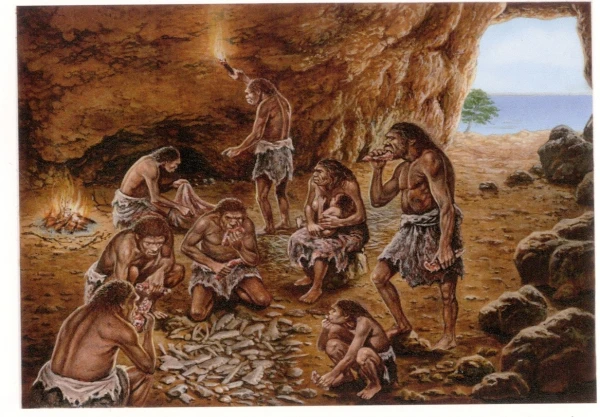
Contrary to previous prevailing notions, the earliest ancestors of humans, who lived more than 2.5 million years ago, passed down the technique of making primitive tools from generation to generation. This skill helped them survive a radical change in climate. This discovery was made by an international team of archaeologists studying the habitat of these ancient people in Africa, in northern Kenya, reports the BBC.
Until now, scientists believed, based on scattered findings, that the earliest ancestors of humans made and used tools sporadically: they invented them and then forgot. However, by studying findings from different layers at the new archaeological site of Namorotukana in Kenya, in the Lake Turkana basin, archaeologists concluded that the ancient ancestor living there, "Homo habilis," transmitted the technique of making stone tools for 300,000 years.
According to the lead researcher, Professor David Braun from the George Washington University in the United States, this discovery requires a radical revision of ideas about human evolution. "We thought that tools appeared only in short bursts and then disappeared. But when we see the same thing for 300,000 years, that conclusion is incorrect," noted Professor Braun, adding that the use of tools likely began much earlier and was more stable than previously thought.
Over ten years of work at Namorotukana, archaeologists found 1,300 sharp scrapers, primitive stone hammers, and so-called "lithic cores." All the tools were made from carefully selected stones taken from the river. This technique is known as the Oldowan culture. Dr. Dan Palchu Rollier from the University of São Paulo in Brazil emphasized that selecting stones based on their properties indicates that ancient people knew what to look for. "These guys were extremely skilled geologists. Their stone tools are magnificent. Some of them can actually cut you," he noted.
Geological data suggest that the art of making tools helped these ancient people survive a radical change in climate in the Central African region, where lush greenery gradually gave way to dry savannas and semi-deserts. According to Dr. Palchu Rollier, this skill allowed primitive people to adapt to changes by modifying their food acquisition methods (technology), rather than through biological evolution.
"The use of tools allowed them not to change their bodies to adapt to changes. Instead, they developed the techniques necessary for food acquisition: tools that could cut animal carcasses and dig up plants," explains the scientist. Evidence of this is provided by animal bones found in Namorotukana that were cut with stone tools. This indicates that despite the climate change, ancient people continued to hunt and eat meat, which gave them an advantage in the struggle for survival.
<iframe width="560" height="315" src="https://www.youtube.com/embed/4H3MpoTfRAU?si=2oHNmW_Avnp0igo5" title="YouTube video player" frameborder="0" allow="accelerometer; autoplay; clipboard-write; encrypted-media; gyroscope; picture-in-picture; web-share" referrerpolicy="strict-origin-when-cross-origin" allowfullscreen></iframe>