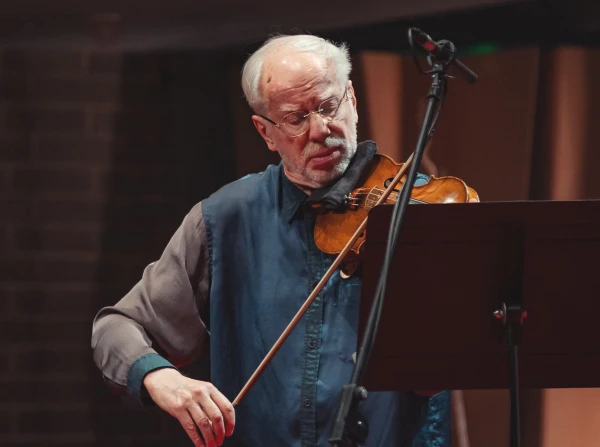
Without exaggeration, Gidon Kremer is one of the greatest violinists of our time. And a native of Riga. Over the course of a month, he appeared several times in Latvia - first incognito, and then publicly.
We All Came Out of the Cinema
In early February, Gidon Markovich was first spotted at the Splendid Palace cinema in Riga, where the premiere of the Latvian film "Frankenstein 2.0" directed by Davis Simanis took place. The appearance of the classical musician at such an unusual film screening caused surprise. Could it be that the outstanding violinist is interested in themes of artificial intelligence and immortality, as discussed in the film?
However, the reason for the musician's appearance became clear a little later, but first, a few words from Kremer himself, spoken to the newspaper "SEGDONYA" immediately after the film premiere.
"This is a serious and intriguing work, but I am not capable of saying how well it achieves its goal. I hope artificial intelligence does not consume - like some crazy politicians - everything human in us."
But then it turned out that the Grammy Award winner and holder of the Imperial Prize in Japan (often referred to as the Nobel Prize for great artists, musicians, and composers) appeared at the cinema not by chance. Gidon recalled sweet moments from his childhood in Riga: he often came here to watch films, and besides, his father, also a violinist - Markus, sometimes played here before screenings. There was a tradition in the 1940s and 50s - the audience was greeted with live music.
Three in One
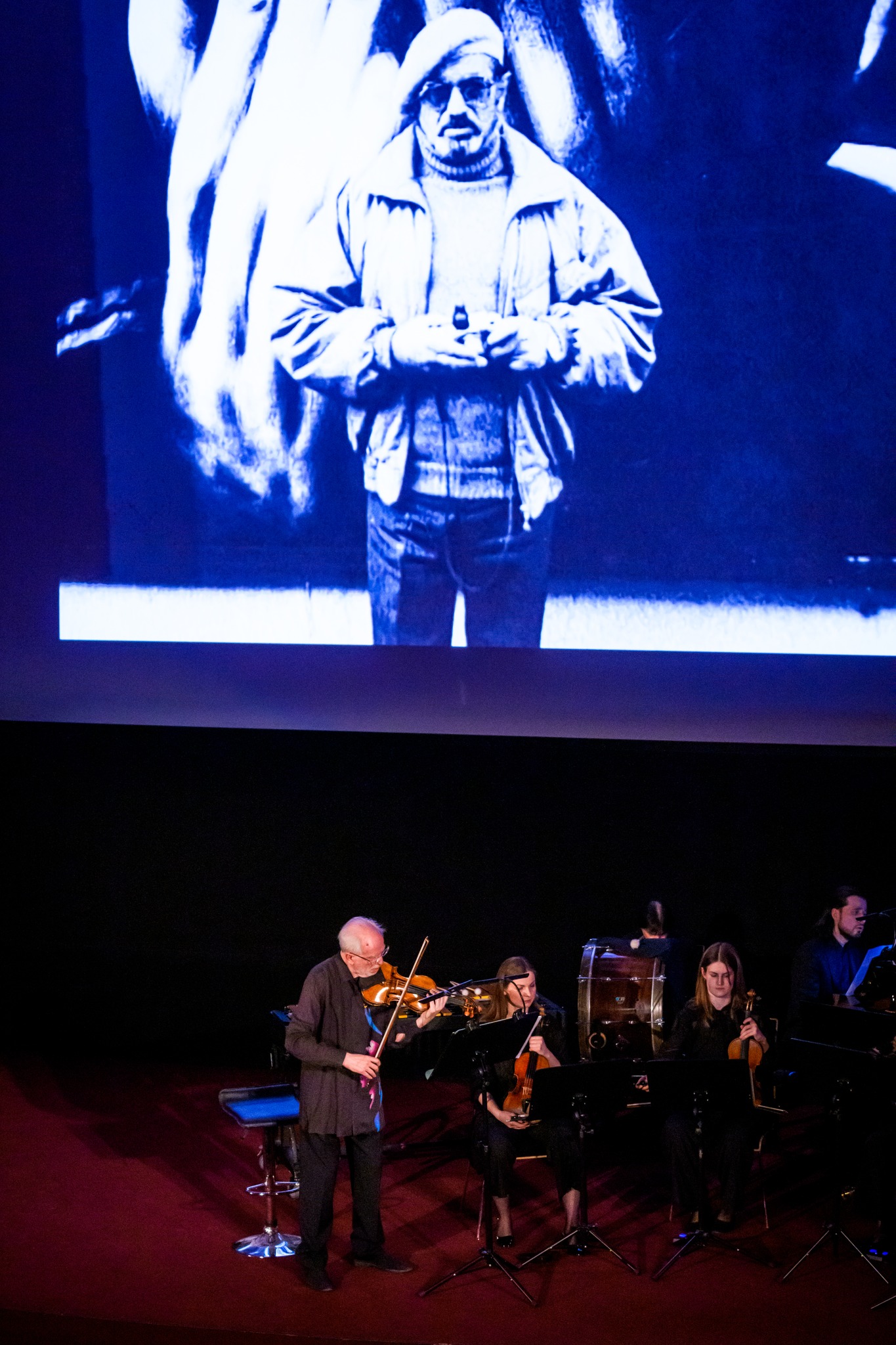
But this time, the classic also checked the acoustics of the beautiful hall - for his concert, which took place a little over a month later. On March 7, Kremer and musicians from his world-renowned chamber orchestra Kremerata Baltica held a concert in memory of the outstanding Latvian documentary filmmaker Hertz Frank, who would have turned one hundred in January.
On February 27, Gidon managed to celebrate his 79th birthday, but where exactly is unknown. Perhaps in Paris or Vilnius, where he has apartments? Or still in Riga? It doesn't matter.
The main thing is that the concert took place - as part of the closing of the ArtDocFest documentary film festival and included a unique triad.
Firstly - a montage created by the festival president Vitaly Mansky from Hertz Frank's films, which have long become classics of world documentary cinema ("Ten Minutes Older," "The Supreme Court," "Flashback," and others).
Secondly - the performance of music by Kremer, the famous Latvian pianist Andrei Osokin, vibraphonist Andrei Pushkarev, and the Kremerata Baltica orchestra (works by Arvo Pärt, Georgs Pelecis, Giya Kancheli, Darius Milhaud, and others were performed).
Thirdly - the breathless audience, witnessing a unique event.
Two Geniuses Met
The multimedia show was based on the idea of the continuity of a person's life path - from birth to death and spiritual rebirth, which fully corresponds to the characteristic philosophy of Hertz Frank, which he expressed throughout his life in his metaphorical films.
"The name Hertz Frank has a special significance for the festival," said Vaiva Bauze, curator of the Baltic Focus competition held as part of the festival. "For us, this is not just a moment of remembrance, but a living artistic encounter. The idea of uniting two geniuses - Hertz Frank in the language of cinema and Gidon Kremer in music - was fundamentally important for the festival."
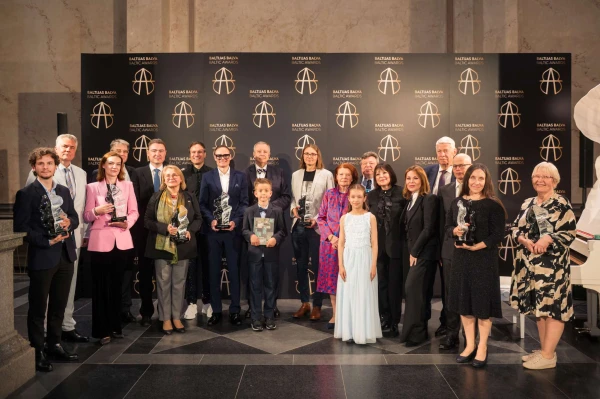
The day before, the great violinist appeared on stage at the concert hall in Cesis, where the main musical awards of the year - the Great Music Awards - were presented. The award went to the outstanding Latvian composer (by the way, Orthodox by faith) Georgs Pelecis.
By the way, Gidon and Georg were classmates at the Emil Darzin Music School, which has become a breeding ground for many outstanding cultural figures who have gained fame worldwide. Among them are violinist Philipp Hirschhorn, musicologist Solomon Volkov, singer Elina Garanca, conductor Andris Nelsons, and many others. And Gidon affectionately calls Georg by the diminutive name "Gosha."
The great violinist performed Pelecis's work "Blooming Jasmine."
What’s Next?
"Every successful concert the next day for me and my team is already 'the past,'" says Gidon. "We must always look forward; only then can we create the future."
He still leads Kremerata Baltica, founded in 1997 and uniting musicians from the three Baltic countries. For almost thirty years, the ensemble has traveled the globe. It is still considered one of the most talented international ensembles in Europe.
Together with the orchestra, Kremer received the first Grammy for Latvia. There are four more Grammys, but they are kept in Boston (USA), where the Latvian conductor led the famous orchestra for 12 years (his contract is now ending). And the Grammy that "Kremerizes" (as they affectionately call it in his close circle) is kept in the orchestra's office in Old Riga. In a few years, along with the office, it will return to the currently being reconstructed Wagner House, for which 50 million euros will be spent with co-financing from Germany.
In February, Gidon Markovich and his Baltic ensemble performed in Istanbul, with the outstanding young French pianist Luca Debargue as the soloist (who, by the way, the people of Riga have fortunately seen about ten times - he comes to us often). Debargue is a permanent resident pianist of Kremerata Baltica, alongside his Latvian colleague Georgijs Osokins (younger brother of Andrei Osokin). And yes, you are welcome to Paris, where in May Kremer and his colleagues will hold three concerts at the Louis Vuitton Foundation.
In the Polyphony of Thoughts
The program of the first concert will include readings of letters from Gidon Kremer, covering various stages of his life and the most outstanding moments of his phenomenal career. Each letter is accompanied by a piece of music that resonates with its content: a musical journey from Johann Sebastian Bach to contemporary compositions (Astor Piazzolla and others).
"Fragments of Life in Letters" is a new project by Kremer. In it, the musician recreates his life - from early years to the present day through letters to family, colleagues, and friends. In the polyphony of thoughts, doubts, revelations, and paradoxes, in dialogue with the surrounding world and with himself, the author's life path emerges from these fragments - sometimes dramatic, sometimes strange, but always unpredictable and full of searches and discoveries.
The second concert is dedicated to American music, featuring works by Charles Ives, Leonard Bernstein, and Philip Glass. The third concert will feature music by Mozart, Englishman Michael Nyman, and contemporary Russian composer Alexander Raskatov.