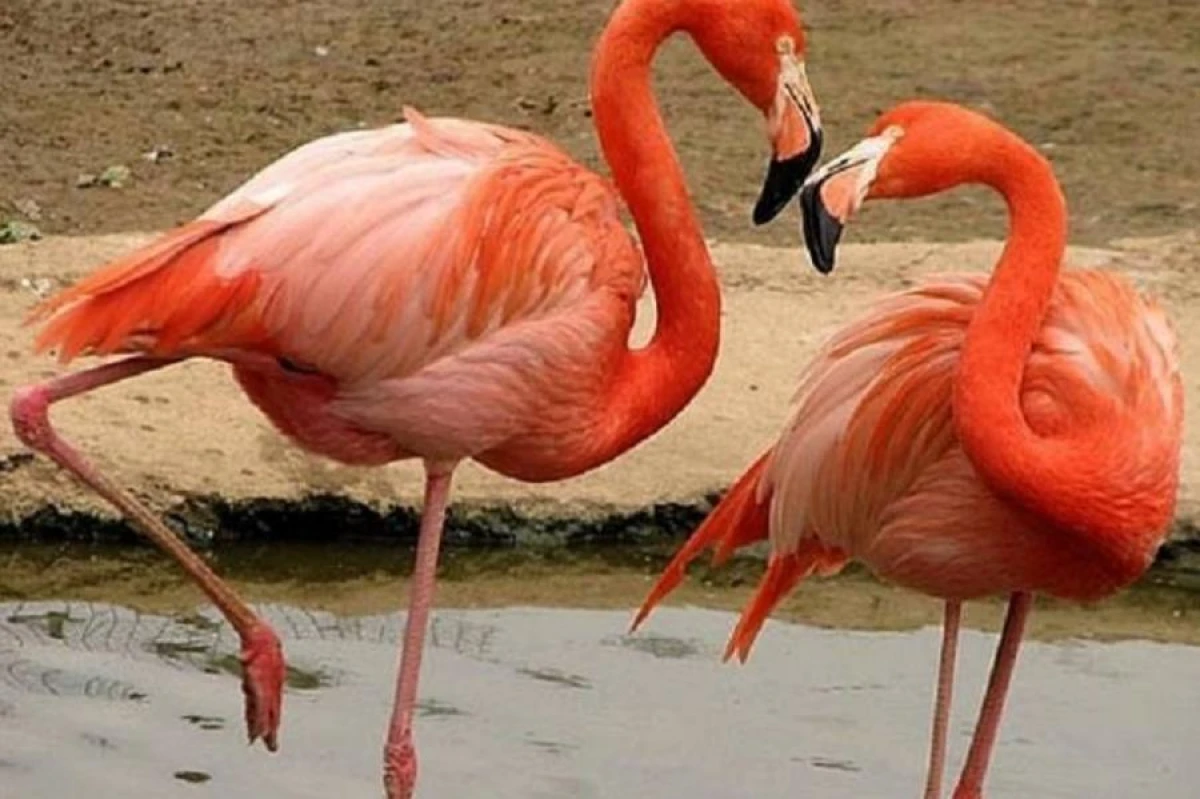
Flamingos are among the most elegant and 'stylish' birds on Earth. Much of their 'style' is due to their bright pink coloration. We will explain how they acquire it.
Some may be surprised, but flamingos are born without their characteristic pink coloration.
According to Science Focus, a person lucky enough to see a flamingo chick may experience confusion. The fact is that the plumage of a young bird is gray.
The color of flamingos develops as they grow and directly depends on their diet. Since their diet mainly consists of aquatic crustaceans and blue-green algae, flamingos absorb a large amount of pigments known as carotenoids.
Spirulina, a blue-green algae, is a favorite treat for flamingos. It is high in protein and other essential nutrients and grows in both freshwater and saltwater bodies. Although algae make up the bulk of a flamingo's diet, they can also eat small invertebrates and fish.
These carotenoids, which, by the way, are the same pigments that turn shrimp pink when cooked, are responsible for the pink color of flamingo feathers. For example, if they start eating only insects or berries, their feathers will turn white or gray again, just like in their youth.
For the same reason, many vegetables and fruits, such as carrots, mangoes, and apricots, acquire red, orange, and yellow hues. However, since humans maintain a varied diet, foods containing carotenoids do not change the color of their skin.
This only works with pink pigments — feeding flamingos blue food dye in hopes of coloring their feathers sapphire will not work.
Dr. Paul Rose, a zoologist at the University of Exeter, states that the food necessary for flamingos to achieve their pink coloration is specific and can be dangerous for other animals: “Flamingos inhabit inhospitable, relatively remote marshy areas — lakes with such alkaline pH that human flesh can burn to the bone. However, in this water lies an untapped food resource, such as crustaceans, cyanobacteria, and diatoms. All of these can be dangerous for many other animals, as they contain toxic chemicals — carotenoids.”
In 2002, British and American scientists conducted a study titled “The Effect of Dietary Carotenoids on Plasma and Plumage Color in House Finches: Intra- and Intersexual Variation.” In this scientific paper, the researchers confirmed the hypothesis that the decorative coloration of flamingos, whose main diet consists of algae, was brighter than that of birds feeding on small animals that eat algae.