
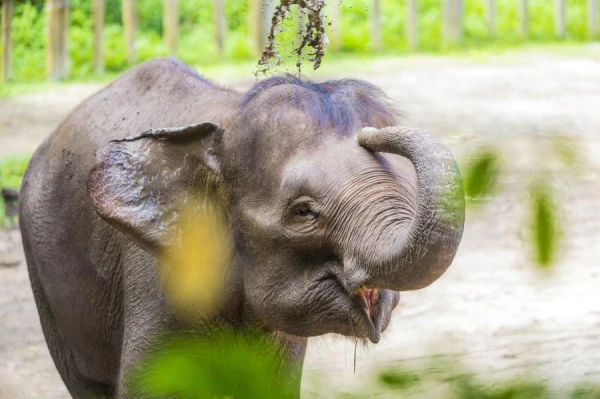
Researchers from the Chinese Academy of Sciences, whose article was published in the journal elife, attempted to determine how elephants developed powerful, flexible, and agile trunks. According to the scientists, this useful adaptation evolved in the ancestors of elephants during their transition from forests to open pastures.
Paleontologists have long been interested in the question: why did the ancestors of modern elephants have an extraordinarily long lower jaw for a long time, which then quickly disappeared, giving way to a long trunk that they began to use to tear grass and place it in their mouths.
To address this question, the authors of the study reconstructed the feeding behavior and ecological niches of three species of extinct herbivores from the elephant family that lived during the Miocene epoch, approximately 11–20 million years ago, in northern China. In the middle of this epoch, the climate in the region changed dramatically, becoming drier, which led to the formation of many open spaces covered with grass.
The scientists concluded that before this climatic change, the long lower jaw was an advantage, allowing all representatives of the three species to efficiently tear plants growing in various directions in forests and gorges. With the emergence of open pastures, where grass stems grew vertically, the advantage shifted to the species with the most versatile lower jaw and the most elongated area of the nose around the nostrils.
Gradually, but at the same time quite rapidly, this ancestor of modern elephants underwent significant changes: the lower jaw decreased, while the nose elongated even further, becoming the primary feeding tool—a muscular trunk capable of curling, grasping grass, and sending it to the mouth. As a result of this natural selection, trunked individuals thrived, while the other two species went extinct.














Leave a comment