
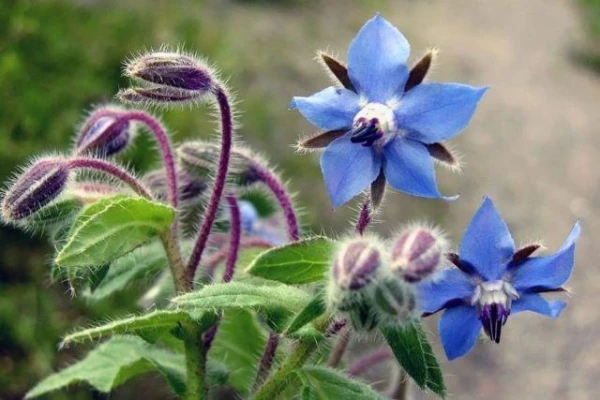
Sharing the experience of gardener and agronomist Alexander Khorobrovets:
- In taste and aroma, borage resembles cucumber, which is why it has a second name — cucumber herb. Ancient Romans and Greeks noted its tonic, medicinal, and honey-producing properties even back then.
Cucumber herb attracts attention: this plant seems to radiate the joy of life. Its leaves are juicy and lush, covered with a light fuzz. The flowers quickly bloom on the stems. However, for culinary use, it is better to collect the leaves before the flowering stem appears; otherwise, the fuzziness can turn into prickly hairs. In such cases, before adding the leaves to dishes, they will need to be crushed. Even when cucumbers are ripening in the garden, borage with its cucumber aroma remains in the diet of gardeners, providing vigor and strength. This is due to the presence of tonic substances in the plant.
The flowers are also edible and can be used to decorate salads. They can be harvested for winter by candying them. The flowers are rich in biologically active substances.
Borage is beneficial for certain skin diseases and rheumatism: compresses made from the leaves are applied to inflamed areas. It also has a diuretic and mild laxative effect. Tea made from borage leaves helps to calm the nerves and strengthen the nervous system. To prepare it, 6-7 leaves are poured with two cups of boiling water and infused for 15-20 minutes.
However, borage has contraindications, so it is recommended to consult a doctor before consumption.











Leave a comment