
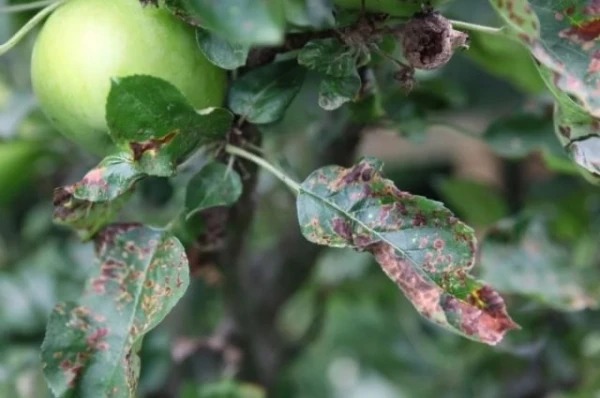
Scab is one of the most serious diseases of apple trees. Therefore, it is crucial to identify this disease in a timely manner and take measures for its treatment.
“The best defense is planting seedlings that are resistant to the fungus Venturia inaequalis, which is scientifically known as apple scab,” says gardener Oleg Kobets. “There are 17 genes that provide immunity to apple trees against scab, and by using their combination, breeders have learned to develop varieties resistant to this disease. However, unfortunately, in the 2010s, scab was able to 'outsmart' the protection of the Rvi6 gene, on the basis of which most of these resistant hybrids were created. This means that in the near future, many varieties will lose their immunity.”
However, this is not a reason for panic, the expert assures. When purchasing seedlings, consider not only the presence of Rvi6 but also the entire pyramid of genes—how many of the 17 protective genes are present in the variety. For example, the variety "Dzhin" has three such genes, "Azimut" has five, and "Vesta" has six. The more there are, the higher the resistance to the fungus.
“Even if you have an old orchard with trees that have lost their immunity, scab is not a death sentence. It can be defeated if you start addressing the problem early in the spring, when the tree has not yet awakened, at the end of March or early April,” emphasizes Oleg Kobets. “The ideal temperature for spores is between 18 and 23 degrees, and it is during the flowering period that the tree is most often infected. Therefore, if you miss the time in spring, in autumn you may end up with a black lump instead of fruit.”
What Needs to Be Done in Autumn
Treating the orchard in autumn will prevent spores from overwintering, and cleaning the tree of microorganisms will improve its health and help it withstand the cold better. This should be done after the harvest but before the cold weather sets in.
“It is better to carry out the treatment after the leaves have fallen, as this will yield the best results. However, many gardeners want to keep the harvest as long as possible, and in this case, they spray with preparations containing trifloxystrobin two weeks before the harvest,” advises Oleg Kobets. “It suppresses not only scab but also powdery mildew and many diseases, including those that affect the fruits during storage. This measure is primarily aimed at preserving the harvest.”
Effective treatment of scab in autumn includes two stages—cleaning and treatment. First, the orchard should be cleared of fallen leaves and dry branches, as spores winter on them. It is best to burn the collected leaves, branches, and affected fruits. Without a thorough cleaning of the orchard, all subsequent measures will be useless.
What Means to Choose for Treating Apple Scab
After cleaning the orchard, choose from dozens of available preparations. “Traditional options include 3% solutions of copper or iron vitriol,” shares Oleg Kobets. “Some prepare Bordeaux mixture—adding 100 grams of unslaked lime and 100 grams of copper vitriol to 10 liters of water. In my opinion, the most effective means are those containing tribasic copper sulfate. Copper ions penetrate the fungal cells and cause irreversible effects leading to its death. Moreover, in Venturia spores, copper reaches a significantly higher concentration than in plant cells, meaning these preparations are safe for trees. Urea also has good antifungal action. It can be added to copper vitriol or tribasic copper sulfate to enhance their effect or used alone.
Urea is popular among organic farming advocates; it is completely eco-friendly and is even used in the production of chewing gum. Its colloquial name is urea. However, urea has a serious drawback—it contains 46% nitrogen. When treating the tree, the fungus is destroyed while simultaneously fertilizing. The nitrogen from urea nourishes the plant and provokes early awakening and flowering. Buds open four days earlier. This is extremely dangerous for orchards in northern and central regions, as it increases the risk of frost during flowering and loss of harvest.
Whichever preparation you choose, avoid common mistakes—treat not only the crown but also the bark and root circle, as spores winter in them too. And under no circumstances should you try to make the preparation stronger; do not exceed the concentration indicated on the packaging to avoid turning the medicine into poison for the plant.”
Reinfection of Apple Trees in Spring
Unfortunately, no one is immune to reinfection. If there is a neglected area with sick trees near your orchard, reinfection is guaranteed at 99.9%. After ripening, spores are ejected upwards by 3-5 centimeters and then carried by the wind up to 20 meters away. The distance is small, but spores can also be carried by insects, birds, and even the orchard owner himself. This happens in spring. Therefore, to protect the treated tree, carry out preventive treatment before flowering begins.






Leave a comment