
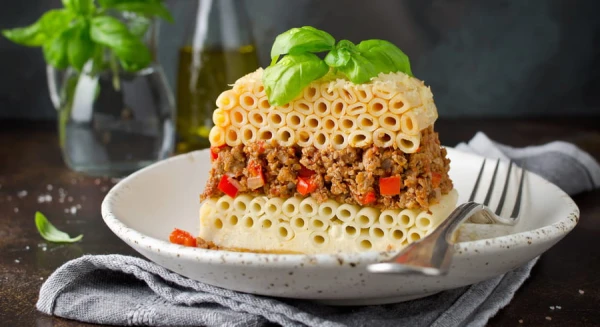
According to Greek women, moussaka and pastitsio are authentic Greek cuisine. These dishes have long been rooted in family traditions, although the béchamel sauce included in their composition became known in Greece only about 80 years ago. These hearty and calorie-rich dishes occupy a central place on the menu and are available in any tavern in the country.
Pastitsio, a simple and delicious dish, is a vivid example of the Greeks' love for pasta. Italians have long debated with them about who owns this national delicacy. The roots of this dispute go back to ancient times when both Romans and Greeks consumed a lot of dough in the form of long noodles resembling spaghetti. However, the Romans preferred to boil it, while the Greeks baked it.
Characteristics of Pastitsio
The name of the dish comes from the Latin word "pasticium," which translates to "mess, confusion, and mixture." This name is quite justified, as pastitsio consists of many components that mix together.
The recipe for pastitsio was brought to Greece from Italy in the late 17th century. It was first prepared on the Ionian Islands and then throughout the country. Depending on the region, the composition may vary:
In Corfu, this name refers to a pasta casserole filled with grated cheese, finely chopped tomatoes, chicken, and eggs, as well as salami and ham. The filling is wrapped in phyllo dough on top, resembling lasagna.
In Crete, there is its own version of the "Venetian" dish, which is served on the last Sunday of Carnival. Here, the base is a mixture of minced meat with beef liver, and the dough is made sweet, making the dish particularly valuable for gourmets.
In the rest of Greece, the classic version is served according to the recipe of Nikos Tselementes. This is a pasta casserole with stewed vegetables, nutmeg, and minced beef, topped with béchamel sauce and grated cheese.
Comparison of Dishes
The similarity between pastitsio and moussaka lies in the fact that both dishes are prepared in layers and contain béchamel sauce.
Moussaka is a layered casserole made of eggplants, lamb, onions, and tomatoes, while pastitsio is a casserole made of pasta, eggs, tomatoes, and minced meat. In terms of taste and appearance, pastitsio resembles a fluffy casserole.
Ingredients for Pastitsio
The classic Greek recipe involves using tubular pasta as the bottom layer. Eggs and cheese serve as the binding component.
The middle layer consists of minced beef with tomato sauce, allspice, and nutmeg. Another layer of pasta is placed on top, after which the dish is poured with béchamel sauce.
Classic Recipe
Ingredients:
500 g tubular pasta;
100-150 g dry white wine;
500 g minced meat (beef or lamb);
1 tbsp tomato paste;
4 tbsp olive oil;
2 cinnamon sticks;
1 onion;
2 cloves of garlic;
nutmeg, pepper, and salt to taste;
1 tbsp butter;
2 eggs;
2 tbsp wheat flour;
0.5 l milk;
100 g hard cheese (preferably Kefalotiri).
Preparation:
1. In a skillet, heat 2 tbsp of oil, then add diced garlic and onion. Sauté the vegetables until translucent.
2. Add the minced meat and sauté, stirring to prevent it from clumping. When the meat changes color, add the tomato paste with spices and wine. Simmer the mixture for 15-20 minutes until the liquid has almost evaporated.
3. In a pot, bring a lot of salted water to a boil and cook the pasta "al dente." Rinse in a colander and let the water drain.
4. Mix the spaghetti with 1-2 tbsp of olive oil and 50 g of grated cheese.
5. Prepare the sauce. Lightly sauté the flour in butter, then add the milk and continuously whisk until thickened. Remove from heat, season (the sauce should be slightly under-salted), and add nutmeg.
6. In a separate bowl, beat the eggs and gradually pour in the sauce while constantly stirring.
7. Grease a baking dish with oil. Place half of the pasta on the bottom, then a layer of minced meat, another layer of pasta, and the remaining part. Pour the sauce over and sprinkle with grated cheese.
8. Place in the oven and bake at 180 degrees until a golden crust forms, about 30 minutes.
9. Cut the finished casserole into portioned pieces.
Source: dietology.pro








Leave a comment