
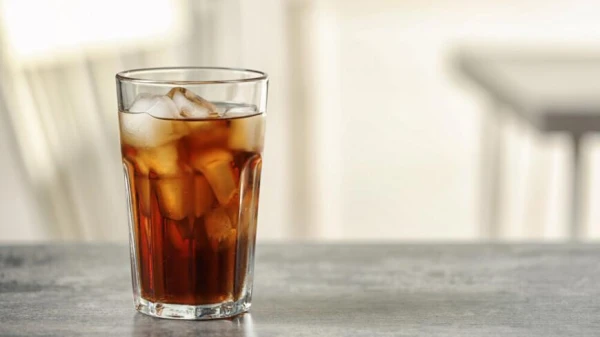
As New Year approaches, many certainly remember the famous Coca-Cola advertisement "The Holiday Comes to Us." You will be surprised, but for some, this drink becomes an important part of the festive table.
You will be even more surprised to learn that in some countries, doctors recommend drinking cola to ease the passage of food when you have overeaten at a New Year's feast. What does this mean? Why is it necessary? The answers to these questions are found in a new study conducted by medical institutions at the University of Amsterdam!
Cola as a remedy
Sometimes doctors may indeed recommend drinking cola or other carbonated beverages, especially during a cold. This is because in some countries, people rarely drink water, and during illness, it is crucial to avoid dehydration. Aryan Bredenoord, one of the authors of the new study, also mentions that he has heard from doctors and read online about cases where doctors prescribe soda for "clearing the throat."
Sometimes a food bolus—a semi-solid mass, usually consisting of meat—can get stuck in the esophagus after swallowing, causing pain and a feeling of pressure. In such situations, people may even be forbidden to swallow saliva!
"This can be really dangerous, so it is important for people to know how to act properly in such cases," noted Bredenoord. "That’s why we decided to test whether this trick with soda really works."
To drink or not to drink?
The researchers recruited 51 adult participants with complete esophageal obstruction due to a food bolus (blocked food in the esophagus); 28 of them drank 25 ml of cola at intervals, while 23 waited for the bolus to pass on its own. In both groups, if complete resolution did not occur, endoscopic removal was performed.
It turned out that cola did not have a significant effect on improving the condition with the food bolus in the esophagus: 61% of participants in the cola group and 61% in the control group reported improvement. In the cola group, 43% reported complete passage of the food bolus compared to 35% in the control group, but the difference was not significant. Partial passage was reported by 18% in the cola group and 26% in the control group. No side effects or complications related to cola consumption were recorded.
"When using cola to liquefy food stuck in the esophagus, no improvements were observed; often the food passed on its own over time, and otherwise, we performed endoscopy," said Bredenoord. "I hope our results dispel this myth."








Leave a comment