
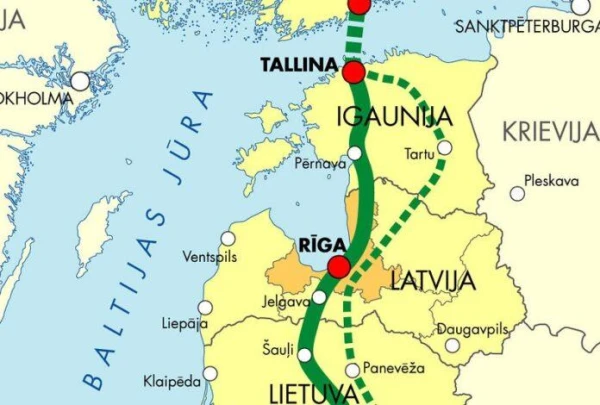
By the end of 2025, the Rail Baltica project in Estonia has reached a decisive stage: construction contracts have been signed for the entire main route from Tallinn to the Latvian border, and active work is underway on more than 100 kilometers. This is stated in the review by Rail Baltic Estonia.
The Rail Baltica railway, stretching 870 km, will run through Estonia, Latvia, and Lithuania to Warsaw and will be built to European standards, has entered an intensive construction phase since 2025. In Estonia, the length of the route is 213 km, and contracts for construction have already been signed for a large part of it, with the land acquisition process completed or legally secured for 86% of the route.
"At the moment, the entire main route from Ülemiste to the Latvian border is covered by construction contracts," said Anvar Salomets, chairman of the board of Rail Baltic Estonia, at the final press briefing. He emphasized that the project has reached a stage where it represents a single railway corridor rather than fragmented sections.
Financial commitments of about 1.1 billion euros have already been made, ensuring long-term stability for the project. The main line is designed for passenger trains at speeds of up to 249 km/h and freight trains at speeds of up to 120 km/h. The project will not only reduce transport emissions but also connect the Baltic countries with the economic space of Central and Western Europe.
In 2026, Estonia plans to announce major tenders for the construction of an international passenger terminal in Pärnu, a freight terminal in Muuga, a rolling stock depot in Ülemiste, as well as for the creation of a traffic management system across the entire main line.
"These are the components that will turn the railway into a full-fledged transport system, linking it with the economy and the daily lives of people," noted Salomets.
In addition to civil transport, Rail Baltica also has strategic significance. The main line is designed with increased load capacity and a wider gauge than standard European railways, allowing it to withstand axle loads of up to 25 tons.
The construction of Rail Baltica has also accelerated in other Baltic countries. In Latvia, work has begun on the main line in the area of Iecava. The completion of the load-bearing structures of the Riga International Passenger Terminal is scheduled for 2026, with passenger service expected to start in 2027. In Lithuania, 77 km are actively under construction, and more than 110 km of the main Rail Baltica route are covered by construction contracts, including major bridges and station infrastructure.
The coming years will be crucial for Estonia, as by the end of the decade the project will move to the stage of installation and testing of systems, followed by commissioning. However, according to Salomets, the most uncertain stage is already behind.
"Previously, the main question was whether the Rail Baltica project would ever be implemented. Now the challenge is its execution: the timely completion of the complex cross-border railway system and ensuring that all accompanying infrastructure is ready by the time train operations begin," he said.














Leave a comment