The SVR statement exposed the "aggressive appetites of the Constantinople Antichrist."
The Russian Foreign Intelligence Service has accused the Patriarch of Constantinople, Bartholomew, of collaborating with British intelligence, reports The Insider, a portal based in Riga.
According to the SVR, British intelligence "actively fuels anti-Russian sentiments in Europe," and the patriarch "has found common ground with the authorities of the Baltic states at their behest." In the agency's statement, Bartholomew is referred to as the "devil incarnate" and the "Constantinople Antichrist."
According to the SVR report, the head of the Constantinople Church has "set his black eye" on the Baltic countries, seeking to oust Russian Orthodoxy from there. The intelligence claims that "Bartholomew, mired in the mortal sin of schism," relies on "local nationalists and neo-Nazis," attempting to detach the Lithuanian, Latvian, and Estonian Orthodox Churches from the Moscow Patriarchate. The document also states that the patriarch has "dismembered Orthodox Ukraine."
The SVR statement notes that the "aggressive appetites of the Constantinople Antichrist" extend to Eastern Europe. The intelligence discusses plans to grant autocephaly to the unrecognized "Montenegrin Orthodox Church," which is expected to strike a blow against the "particularly rebellious" Serbian Orthodox Church.
The SVR document concludes with a quote from the Sermon on the Mount about false prophets who "come in sheep's clothing, but inwardly are ravenous wolves." According to the intelligence, "church circles" note that Bartholomew is "literally tearing the living Body of the Church apart."
The patriarch was born on February 29, 1940, in the village of Ayios Theodoros on the island of Imbros (now Gökçeada) in Turkey. His parents were Christos Archondonis and Meropi Archondoni. Ethnically, he is Greek.
He studied at schools in Imbros, graduated from the private Greek Zografos Lyceum in Istanbul, and then entered the Halki Theological School on Heybeliada Island, graduating in 1961 with a dissertation on the topic: "Restoration of a Dissolved Marriage."
On August 13, 1961, immediately after finishing Halki, he was ordained a deacon in the metropolitan church of Imbros by his spiritual father, then Metropolitan Meliton (Chatzis) of Imbros. At his ordination, he was given the name Bartholomew in honor of Bartholomew of Kutlumush, the publisher of the Menologion and other liturgical books, who was from Imbros and is considered its enlightener.
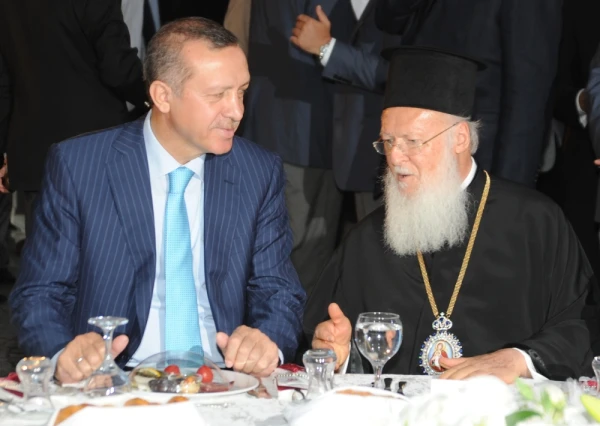
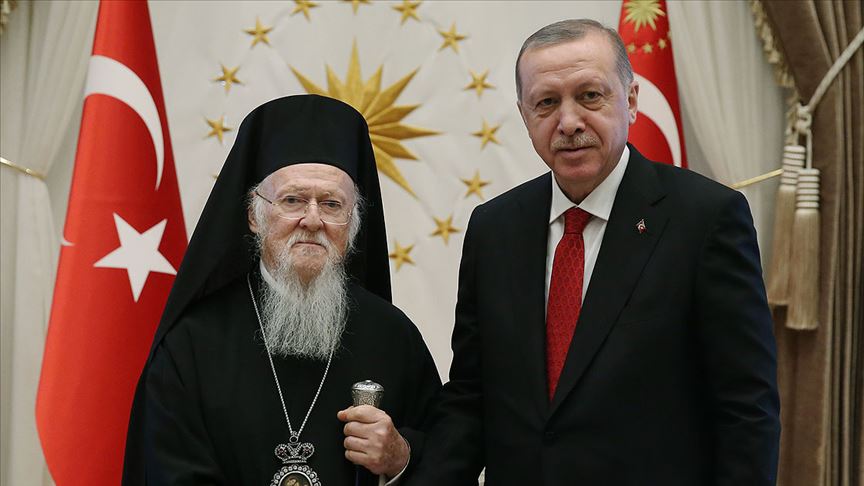
As a citizen of the Republic of Turkey, from 1961 to 1963, he served his military duty as an officer in the Turkish army. He frequently met with Turkish President Erdoğan, as well as politicians from Greece.
From 1963 to 1968, he studied for his doctorate on a scholarship from the Patriarchate of Constantinople at the Pontifical Oriental Institute in Rome, the Bossey Ecumenical Institute in Switzerland, and the University of Munich. He received a doctorate in canon law from the Pontifical Gregorian University in Rome, defending a dissertation on the topic "On the Codification of Sacred Canons and Canonical Sacraments in the Orthodox Church." He had a penchant for studying many foreign languages (in addition to his native Greek, he also speaks English, French, German, Italian, Turkish, and Latin), which helped him study foreign scientific literature and communicate with many people throughout his years of study.
After completing his doctoral studies in Europe, he returned to Istanbul in 1968 and was appointed assistant rector of the Theological School on the island of Halki, where he was to teach canon law as a full professor. In 1969, in the chapel of the Theological School, he was ordained a presbyter by Metropolitan Meliton (Chatzis) of Chalcedon, and six months later, Patriarch Athenagoras of Constantinople granted him the title of "archimandrite" in the patriarchal chapel of Saint Andrew the First-Called. In 1971, the Turkish state suddenly prohibited the activities of the Halki Theological School, so his dream of an academic career did not come true.
In 1972, Metropolitan Dimitrios of Imbros and Tenedos was elected patriarch, after which he established a special patriarchal chancery, appointing the young archimandrite Bartholomew (Archondonis) as its first director.
On December 25, 1973, he was consecrated as a bishop with the title of Metropolitan of Philadelphia, while remaining in the position of head of the Patriarchal Chancery. At that time, he was the youngest metropolitan of the Constantinople Orthodox Church: he was only 33 years old. As the head of the newly established private patriarchal chancery, he remained until his election to the Chalcedon Metropolitanate in January 1990.
From March 1974 until his patriarchal enthronement, he was a member of the Holy Synod and several synodal committees.
In January 1990, he was appointed Metropolitan of Chalcedon. He was elected primate of the Constantinople Church on October 22, 1991, with the enthronement ceremony taking place on November 2 of the same year.