
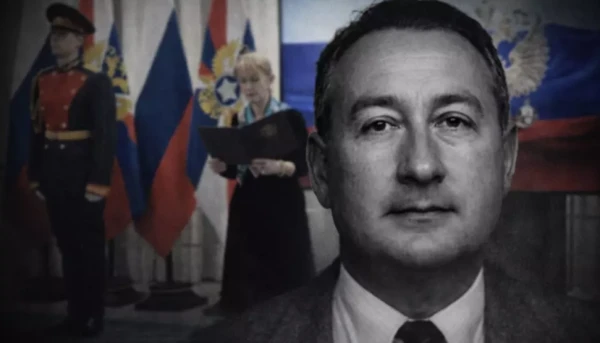
50 years ago he visited the USSR, where he was warmly received and taken to Central Asia and the Black Sea resorts.
During the height of the Cold War, for nearly twenty years, a high-ranking French official with an impeccable reputation, Georges Pak, transmitted secret documents to the USSR. More than 60 years later, his daughter and grandson received Russian passports from the head of the SVR, Sergey Naryshkin, and moved to St. Petersburg. Now they reproduce the theses of Kremlin propaganda and associate their future plans with Russia.
In Russia, its new citizens brought the archives of Pak — a high-ranking official who held senior positions in various ministries and departments, including the French Ministry of Defense and the NATO headquarters in Paris.
The publication Le Point, which published the story of Pak's daughter and grandson, describes the main French informant of the KGB during the Cold War as a "mystery." Georges Pak was not a communist. On the contrary, he was a devout Catholic who attended mass every Sunday. He did not lead a double life, had no debts, and was considered a man of impeccable reputation. Throughout his life, he believed that the influence of the United States should be balanced — so that "France retains the full weight of its political presence on the world stage."
French writer Pierre Assouline, author of the novel Une question d’orgueil ("A Question of Pride") dedicated to Pak, is convinced that the main motivation for the official was a sense of his own exceptionalism.
"Pride was the only thing that drove him; he considered himself better than other politicians, all those who held higher positions," he said.
By passing secret materials to the KGB, Georges Pak "wanted to enter history." "He saw himself as an all-powerful shadow minister, convinced that he was single-handedly saving the world from a third world war! Such intentions can lead to the scaffold," emphasized Assouline, who once communicated with the informant and spent several hours with him.
A graduate of one of the most prestigious educational institutions in France, the École Normale Supérieure, from 1944 until the beginning of 1958, Georges Pak was part of various ministerial cabinets of the Fourth Republic. From April 1, 1958, he worked in the General Staff of National Defense of France and later became the head of training programs at the Institute of Higher National Defense Studies (IHEDN). In November 1962, Pak took office as deputy head of the NATO press service in Paris.
Algeria
"It all started in Algeria in 1944. For four years, we lived in an atmosphere of tension, and our minds were pursued by only two goals: to defeat Germany and to propose a new world order in which war would be impossible. I believed that the USSR would play a crucial role after victory," Pak wrote in his confessional testimony after his arrest.
Georges Pak was born on January 29, 1914, in Burgundy, in the city of Chalon-sur-Saône, to a family of hairdressers. The family lived in a small two-room apartment adjacent to the salon. "Throughout my childhood, I lived with the thought that I needed to work, work, and work non-stop to achieve something," Pak recalled in one of the rare interviews with lawyer and writer Charles Benfredj, who wrote a book about him.
A brilliant student, he entered the École Normale Supérieure in 1935, one of the most prestigious educational institutions in France. After obtaining an agrégation in Italian, he taught it in Nice and then in Rabat, Morocco. In North Africa, Pak joined the army of resistance movement participant General Henri Giraud, became the political leader of the local branch of the Resistance radio Radio Alger under the pseudonym René Versailles, and in March 1944 took the position of chief of staff to the Minister of Naval Affairs in Algeria, Louis Jacquinot.
The question of how exactly Georges Pak's collaboration with Soviet intelligence began is interpreted differently in various sources. According to French journalist Thierry Wolton, author of the book "KGB in France," as well as in official Russian publications, particularly from the SVR, Pak allegedly initiated contact with Soviet representatives in Algeria as early as 1943.
In Russian sources, this version is supplemented by the assertion of direct recruitment. For instance, in a film by the Zvezda channel, former KGB foreign intelligence officer Arsen Martirosyan states that Georges Pak was recruited by the Soviet resident in Algeria, Nikolai Gorshkov. The official website of the Russian Foreign Intelligence Service, in Gorshkov's biography, states that in 1943–1944, while serving as a foreign intelligence resident in Algeria, he "personally recruited a prominent government official of France," from whom Soviet intelligence received important political information for fifteen years — first about France and then about NATO.
Several French sources date the beginning of these contacts to 1944 and link them to Pak's acquaintance with doctor Imek Bernstein. A former participant in the International Brigades in Spain, a communist, and an agent of the Comintern in the 1930s, Bernstein introduced Pak to his "friend," Alexander Guzovsky, the first secretary of the USSR Representation to the French Committee of National Liberation and a KGB officer (Guzovsky was repressed in 1947 and released after Stalin's death in 1954). Guzovsky spoke French and managed to convince Pak that the USSR was a "peaceful and selfless country." Pak and Guzovsky's meetings quickly became regular: during them, the Frenchman shared with his new acquaintance what he saw and heard in the commissioner's office during informal conversations.
Paris
In liberated Paris, meetings continued — now with another KGB curator — and took on a more official character. Pak began to pass valuable information and secret documents to Soviet agents. The French official quickly climbed the career ladder and frequently changed positions: he worked in the Ministry of Reconstruction and Urbanism, the Ministry of Health, the President's administration, the Ministry of Maritime Trade, the Ministry of Industry, and finally in the press services of the Ministry of Defense and the NATO headquarters in Paris.
From 1945 to 1963, Georges Pak maintained contact with seven successive Soviet handlers. He began to provide services to the KGB particularly actively after 1958, when he took a position in the press service of the French General Staff.
Pak "transmitted to the KGB all documents that passed through his hands and which, in his opinion, could interest the Soviet side," notes the French Internal Security Service (DGSI):
He provided information, files, and very important secret documents related to national defense and NATO. This includes reports on relations with the East and on the defense of Berlin, intelligence bulletins, studies on Eastern European countries, Africa, and Cuba, economic reviews, as well as the defense plan for Western Europe.
After his arrest, the official admitted that he prepared biographical references and psychological profiles of French political figures, many of whom he criticized. This information likely allowed the Soviet side to "recruit or attempt to recruit other agents."
At the same time, Pak acted extremely imprudently, "at a surprisingly amateur level," emphasizes the author of the study dedicated to him, French historian Bernard Hautecloque.
The KGB tried to teach the informant more secure methods of operation, but he struggled with the technique and refused to use the existing cameras at the time. Every two weeks, Pak simply left the office during lunch breaks with a folder of secret documents in his briefcase, handed them over to his handler, and picked them up a few hours later. "The fact that he was not exposed during routine checks is a matter of incredible luck," believes Hautecloque.
Pak was a sociable and sincere person, and most of his high-ranking friends remained loyal to this friendship even after his arrest, serving as character witnesses during the trial.
Exposure
At the end of 1961, the head of the KGB residency in Finland, Anatoly Golitsyn, who worked at the USSR embassy in Helsinki under diplomatic cover, requested political asylum at the American embassy and was secretly transported to the USA via Stockholm. During interrogations by the CIA, he reported, among other things, that top-secret NATO documents were systematically transmitted from Paris to Moscow. In May 1962, French intelligence gained access to part of his testimony.
At the same time, as the author of the book "KGB in France" Thierry Wolton emphasizes, Georges Pak took the position of deputy head of the NATO press service only in the fall of 1962 — that is, already after Golitsyn's flight to the West. Therefore, the initial suspicions concerned not a specific person but the very fact of information leakage from the Alliance's structures.
It was in this form that the defector's information was used by the French counterintelligence. DST employees began a long and painstaking verification: over several months, the circle of suspects within NATO structures gradually narrowed — from about a hundred employees to several dozen, and then to just a few individuals.
Feshroll
A differently described episode in one of the suburbs of Paris became a decisive signal for French counterintelligence. On August 10, 1963, in the small town of Feshroll, west of Paris, DST officers were conducting surveillance on Georges Pak, who had been under unofficial control for several months.
That day he arrived in the town, dressed in a suit and hat, with a briefcase in hand, and wandered aimlessly through the streets for a long time, periodically stopping, changing direction, entering cafes and churches. His behavior seemed tense and not coincidental — he was clearly expecting a meeting.
Soon, a car entered Feshroll, driven by a diplomat from the Soviet mission to UNESCO, well known to French counterintelligence as a KGB agent. He drove down the main street several times, stopping and carefully surveying the surroundings. However, the decisive moment — the transfer of documents or a direct meeting — never occurred. The contact was disrupted.
Nevertheless, for counterintelligence, this was enough. There were too many coincidences to wait. Two days later, on August 12, 1963, Georges Pak was detained while leaving the NATO headquarters in Paris.
At first, he denied the charges but quickly provided a written confession. On 14 pages, he detailed the history of his work for the KGB, and at the end, naively asked the DST officers not to inform his wife and daughter about what had happened. A priest was called to Pak, who heard his confession.
During interrogations, Pak claimed that he "never transmitted anything related to the military, technical, or scientific potential of France." "However, I decided — not without painful inner struggle — to provide the Russians with information necessary to maintain peace in the world," he stated.
This concerned the transmission of NATO military plans during the Berlin crisis of 1961, as well as the location of NATO radar stations in Turkey during the Cuban missile crisis of 1962.
"I am convinced that the Americans, due to their rather primitive ideas, are dangerous warmongers. Therefore, I deemed it necessary — to prevent an international conflict inevitably leading to a global catastrophe — to restore the balance of power."
Bernard Hautecloque writes that if Pak had not confessed to working for the KGB himself, it would have been extremely difficult to bring charges against him: during a search of his apartment, no compromising documents or other evidence allowing for the establishment of his involvement in espionage were found.
Trial
The trial of Georges Pak opened in July 1964 at the State Security Court (this special tribunal existed until 1981 and was abolished by socialist president François Mitterrand. — RFI), lasted only two days, and was widely discussed in the media. Some sessions were held behind closed doors. The prosecutor demanded the death penalty for Pak.
"I took a great risk, even the highest sacrifice, for the sake of preserving peace. [...] I thought only of the good of France. I was not a Soviet agent. The Russians mean nothing to me," the accused stated in his final words. "I am not a Marxist," he insisted. "I was guided by a sense of religious and moral duty."
In court, the prosecutor described Georges Pak as a man "with a complex mind, highly educated, but naive, as is often the case with intellectuals soaring at the peaks." According to him, "Pak was not adapted to the realities of this world."
Caught in a strange combination of naivety and megalomania, Pak saw himself as something like a second foreign minister. After his arrest, he seriously claimed that he single-handedly prevented World War III, Hautecloque writes. Moreover, the official believed that it was thanks to him that the Berlin Wall was erected. This version is also defended today by official Russian sources. Four years ago, for instance, the Zvezda channel released a documentary about Pak titled "The Godfather of the Berlin Wall."
On July 9, 1964, Georges Pak was found guilty of treason with mitigating circumstances and sentenced to life imprisonment. In the Melun prison near Paris, he spent less than seven years. While in prison, he learned Russian. In May 1970, the informant was pardoned by President Georges Pompidou.
After his release, Pak, through connections, found a position at the Paris Chamber of Commerce, where he worked until 1979. He engaged in literary activities, wrote an autobiographical novel, translated from Italian, refused to communicate with journalists, and died in 1993, just short of his 80th birthday.
In 1975, he visited the USSR, where he was warmly received and taken to Central Asia and the Black Sea resorts. The trip to the Soviet Union both inspired and disappointed the former informant. In a conversation with writer Charles Benfredj, he admitted that "the population did not seem to him either poor or unhappy." "But the ideology that once inspired him turned out to be a harsh system of restrictions. In dreams, we always embellish reality — especially if we have never faced it directly," the writer emphasized.
"Legendary Helper and Friend of the Soviet Union"
"Your father was a devoted friend of the Soviet Union. As a convinced anti-fascist, an active participant in the anti-fascist movement within the organization 'Fighting France,' he proactively established contact with Soviet foreign intelligence," Sergey Naryshkin stated during the citizenship ceremony for Isabelle Pak.
Isabelle Pak, quoted by Russian propaganda media, told those present that the "culmination" for their request to be accepted with her son into Russian citizenship was the Western "propaganda unleashed around the special operation in Ukraine." In her social media account, Georges Pak's daughter reproduces traditional narratives of Russian propaganda about neo-Nazis in Ukraine, the imposition of LGBT agendas in France, and sharply criticizes President Macron.
On the eve of receiving Russian citizenship, she gave an interview to historian of Russian special services and journalist of the Rossiyskaya Gazeta, Nikolai Dolgopolov.
The France that exists now is not like the France where I was born. The French are frightened by war. And if it breaks out, which I do not believe, then I prefer to die here in Russia. My son and I made the right decision. And without the help of our friends — my father's loyal Russian comrades in intelligence — the process could have dragged on for a long time. It is thanks to their efforts that we are receiving Russian passports today. Our deep gratitude," she said in this conversation.
A mother of three children, Isabelle Pak studied at the journalism faculty of Moscow State University — at the invitation of the Russian side. In Moscow, she learned Russian, got married, and gave birth to a daughter, Tatyana.
Upon returning to France, Isabelle Pak kept a low profile. Pierre Assouline, the author of the novel about Pak, was unable to locate her when writing the book.
In 2015, Isabelle Pak briefly appeared in the public space: she ran for regional elections in Burgundy from the far-right party "National Front" (now "National Rally") of Marine Le Pen. At that time, according to her acquaintances, her political motivation was reduced to a "fear of the decline of France." Today, this fear has transformed into a definitive break with French society and a symbolic choice of the other side.




Leave a comment