
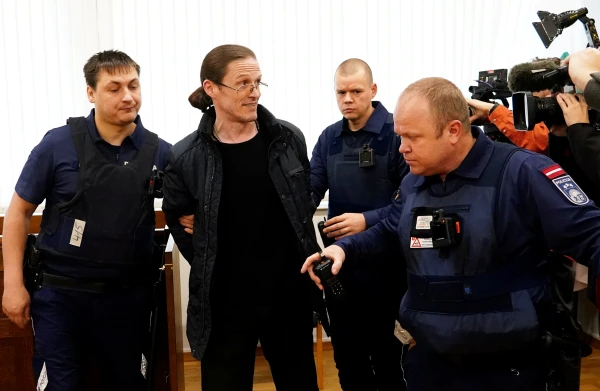
New developments in the case of the murder of lawyer and insolvency administrator Martinš Bunkus: one of the defendants has likely forged documents to secure an alibi. This conclusion was reached by the victims — relatives of the deceased, whose lawyer in Russia conducted his own investigation and uncovered the forgery. In Latvia, the police have initiated a criminal case regarding the use of forged documents in court, reported the program "Nekā personīga" (TV3).
According to the indictment, it was Viktor Krivoshey who fired fatal shots at Martinš Bunkus from a moving vehicle on May 30, 2018. Initially, he himself confirmed this to the police. Later, Krivoshey changed his testimony, claiming that he did not know the deceased, did not commit the crime, and was in Russia at the time of the murder. This was allegedly confirmed by documents issued by Russian institutions.
Krivoshey called his confession in the spring of 2022 fabricated: he claimed he took on someone else's guilt. Since August of that year, he has insisted that he has an alibi — he was in Moscow, visiting doctors, and the next day was fined for violating traffic rules. Therefore, he could not be the murderer and did not receive any instructions from Gennady Valyagin (designated in the indictment as the organizer of the murder), nor is he acquainted with him.
To confirm his alibi, while in the Olaine prison, Krivoshey issued a power of attorney to Russian Andrey Uvarov, who collected evidence in his defense. His lawyers repeatedly referred to documents in court that allegedly confirmed Krivoshey's presence in Moscow. This was also used in the arguments of the defenders of other defendants — businessman Mikhail Ulman and Alexander Babenko.
As evidence, a document was presented stating that on May 30, 2018, Krivoshey was allegedly at a doctor's appointment at the Pletnev Clinical Hospital in Moscow. The certificate was signed by acting deputy chief physician Sergey Yakushev and stamped by the hospital.
However, Martinš Bunkus's brother hired a lawyer in Moscow — Rotislav Yakiro, who found that the certificate was a forgery. In a private conversation, a lawyer from the clinic admitted that a document with such details was not issued, and the signature was forged. There are no records of Krivoshey's visit in the hospital's information systems.
The Moscow police summoned Yakushev, and he confirmed that in the summer of 2024, he indeed sent a response to Uvarov, but the text in the document presented in the Latvian court does not match the original. The official response was a refusal to confirm Krivoshey's visit to the hospital and the impossibility of issuing medical documents. Yakushev's signature on the forged certificate turned out to be fake.
Lawyer Yakiro also discovered forgery in another "evidence" of the alibi — a protocol of a fine for a traffic violation, allegedly drawn up the day after the doctor's visit. According to the materials, the specified intersection is not equipped with a traffic light, and at that location in 2018, there was a construction site. Moreover, the form of the protocol does not correspond to that used in Russia, and the document mistakenly states that the fine was imposed under the laws of the Krasnodar Territory — which are not applicable in Moscow.
Yakiro noted other oddities: there is no traffic police division in the area of Filёvsky Park mentioned in the protocol, and the Ministry of Internal Affairs of the Russian Federation officially confirmed that Krivoshey had not been subjected to administrative liability. According to the lawyer, Krivoshey most likely signed the forged document himself while already in custody in Latvia.
The victims filed a complaint with the State Police of Latvia along with all the collected materials. On January 9 of this year, a criminal case was initiated under Article 300.1 of the Criminal Code of Latvia — for the use of forged material or written evidence.
A representative of the State Prosecutor's Office, Simona Gravite, confirmed the fact of the case initiation and explained that it is currently classified under this article.
Krivoshey has several lawyers. His legal representative is attorney Renars Briedis, and in court, his alibi was actively defended by lawyer Iveta Vietniece.
In a conversation with the program Nekā personīga, Vietniece admitted that she did not verify the authenticity of the documents in Russia:
– Nekā personīga: How did you, as a lawyer, ensure the authenticity of the documents confirming Krivoshey's alibi? – Vietniece: Why should they be fake? – Nekā personīga: I am asking how you checked this? – Vietniece: According to my client and by visually inspecting the document. He issued a power of attorney to the person who obtained these documents and involved a lawyer. – Nekā personīga: Did you call the hospital yourself to check? – Vietniece: No, of course not. How can I call another country and check something?
By law, the use of forged evidence is punishable by imprisonment for up to one year.
A complaint about possible forgery was also submitted to the Riga Regional Court, which will have to assess these circumstances.







Leave a comment