
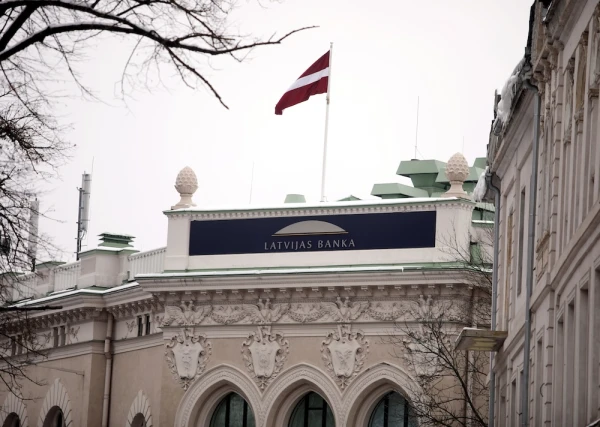
The Latvian economy is expected to see cautiously positive trends this year, including stabilization of inflation and wage growth, however, attention is required for the excessively large role of the state in the economy and insufficiently rapid growth, said Bank of Latvia economist Oleg Krasnopjorov to the LETA agency.
According to an economist, three factors that allow for cautious optimism regarding the next year are price stability, a more favorable external environment, and an increase in societal wealth.
He points out that the European Central Bank (ECB) Council has managed to bring inflation in the eurozone back to the target level of 2% per year, which is an optimal indicator for economic development. The period of high inflation has been overcome, and companies and residents no longer need to worry about excessively rapid price increases and the devaluation of money. Therefore, there is also no reason to expect significant changes in interest rates in the near future, as confirmed by comments from ECB Council members in recent months.
In Latvia, however, inflation is currently and is expected to remain slightly above 3% in the coming years. Rapid wage growth is driving up the cost of labor-intensive services, while prices for products in the cheap brand segment in Latvia remain high. Although in recent months, food prices have slightly decreased under the influence of a global decline, this trend remains fragile.
The economist emphasizes that there is still much to be done next year to enhance competition among retailers. Previously, weak competition was also observed among commercial banks, which made loans expensive and the conditions for obtaining them strict. The year 2025 became a turning point in this area — now lending supports the economy rather than following it, which promises higher investments and economic activity in the future.
Krasnopjorov also points out that the negative impact of the trade war, which began with loud statements, on the global economy turned out to be less than expected.
Moreover, societal wealth is increasing. The average wage growth in Latvia is expected to be around 8% per year, which is at least twice as fast as inflation. This means greater material wealth and the ability to purchase more goods and services. The unemployment rate will also remain low, making the labor market favorable for workers, prompting entrepreneurs to actively implement automation solutions, and encouraging government policy to activate internal labor reserves.
At the same time, the economist highlights two problems that need to be addressed — the excessively large role of the state in the economy and insufficiently rapid economic growth.
Krasnopjorov explains that over the past six years, the state sector has significantly increased its share in the Latvian economy. Before the Covid-19 pandemic, government spending accounted for 40% of the economy, now it is already 46%, and the growth significantly exceeds the level that could be justified by defense needs.
"The increase in government spending could be desirable during periods of economic crises (for example, during the pandemic or in 2022 against the backdrop of a sharp rise in energy prices), but not now. We should also not tolerate an annual budget deficit at or even above 3% of the economy," the economist states, explaining that excessive budget deficits increase public debt and the costs of servicing it — hundreds of millions of euros must be allocated each year for interest payments on debts.
When choosing between two paths to reduce the budget deficit, an unconditional preference should be given to cutting government spending. An alternative solution would be to increase the tax burden, but this would negatively impact economic growth.
Krasnopjorov notes that growth rates of 1–2% in the European Union and 2–3% in Latvia are quite modest results.
There is currently no economic crisis, and Latvia is no longer a country with cheap labor. Economic development for Latvia is not just about producing more of the same but moving towards creating unique, high-quality, and complex goods and services with high added value.
Governments should not manage this growth process through a plethora of plans, strategies, and excessive support mechanisms, but primarily foster the creation of an excellent environment for entrepreneurship and living, where entrepreneurs and residents would want and be able to realize their talents.
At the EU level, economic growth can be supported through a unified European capital market, which would allow a larger portion of Europeans' savings to be invested directly in European companies rather than in the US and other regions, a single services market so that more companies can grow beyond national borders, achieving economies of scale, as well as through the elimination of excessive bureaucratic barriers to entrepreneurship and labor activity. One step in this direction is the simplification of banking sector regulation, which was discussed in 2025 and will become a priority for the ECB and the EU in 2026.
Krasnopjorov notes that the successes of the Latvian economy are significant; however, examples from neighboring countries should be used, and higher standards of living should be aspired to.








Leave a comment