
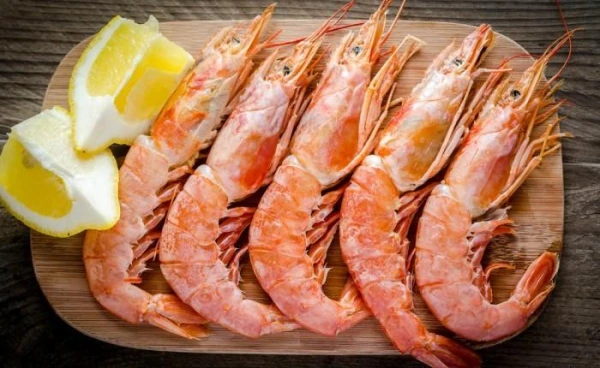
Shrimp rank among the leading seafood that has become an integral part of our diet. They can be used as a standalone dish or in salads or appetizers. To simplify the selection process, producers have developed an original classification system for shrimp, which will help you navigate this issue. We present to you a guide to choosing shrimp.
How to Properly Determine the Caliber of Shrimp
When purchasing shrimp, we often encounter frozen products. Bulk shrimp without a specified name are cheaper, but there is a risk of acquiring snow, ice, and seafood that has been thawed multiple times. Quality producers care about their reputation and package their products according to all standards, leaving a window on the packaging for checking the declared caliber size. It is important to remember that quality requirements can vary significantly.
Atlantic cold-water shrimp are generally small, and their calibers are represented as follows: 50–70 (pieces per kilogram) — select; 70–90 — medium size; 90–120 — small. The colder the water in which the shrimp live, the smaller and juicier they are. Northern deep-water shrimp rarely exceed the size of 31–40. These shrimp are perfect for salads, appetizers, and soups, while the small ones are often used in Scandinavian cuisine for toasts and smørrebrød.
Tropical or warm-water shrimp are divided into two main types: tiger and royal. They are significantly larger than cold-water shrimp (up to 25 cm in length), and their calibers look like this: 31–40, 21–30, 16–20, 12–16, 8–12, 6–8, 4–6, 2–4. The shrimp of the latter calibers are true “monsters” compared to Atlantic ones. This, in turn, is reflected in the price, which is significantly higher. Such shrimp are usually cooked with vegetables.
Choosing Shrimp: Unpeeled, Peeled, and Cleaned
Shrimp can be purchased unpeeled, peeled (without the head), or cleaned (without the head and shell). Unpeeled options are cheaper, but this does not always mean that their purchase is more advantageous. For every 1 kg of peeled shrimp, there are usually about 3 kg of unpeeled shrimp.
The calibers of peeled shrimp are also designated by piece, but not by kilogram, rather by the English pound (454 g). The reasons for this approach by producers remain a mystery. There are also original caliber designations in the form of letters resembling clothing sizes, such as XL or XXL. However, to understand the exact size of the shrimp, one needs to look at the packaging.
Nevertheless, any packaging must include words that help determine the caliber. Extra Colossal, Super Colossal, Colossal, Extra Jumbo, and Extra Large are typically warm-water shrimp. Large, medium, small, and very small are cold-water shrimp, whose caliber is almost always below 31–40.
The Advantages of Choosing Smaller Shrimp
In the matter of “size — price,” there are many nuances. Larger shrimp are easier to work with in the kitchen, especially if using professional cooking methods: tiger shrimp with characteristic stripes on their shells, which are farmed in the Mediterranean, Malaysia, Taiwan, and other Southeast Asian countries.
In countries where the size of shrimp is viewed more calmly, Atlantic cold-water shrimp are considered exotic due to their taste qualities and high vitamin content, as well as their relatively low yield: only a small portion of the total catch of warm-water shrimp. We are talking about select Atlantic shrimp of caliber 50–70. Calibers 120 and above are already considered “krill.” It is also worth noting that the shells of shrimp are used to make flavorings and “crab oil,” which adds an additional Atlantic flavor. Therefore, despite the loud names of tigers and kings, the meat of smaller Atlantic shrimp is valued higher worldwide.
Glazing Shrimp
When storing seafood and fish, it is important to cover them with a layer of ice known as glaze. This helps reduce the mass of the product during long-term storage and maintain its quality. Immediately after being caught, shrimp are boiled in seawater and then quickly frozen at a temperature of -25–30 °C.
However, anything that the consumer cannot check immediately may tempt unscrupulous suppliers.
What is a Good Sign...
Frozen shrimp should have an even color, a thin “glaze,” and a curled tail.
A brown head indicates a pregnant shrimp, and its meat is very nutritious.
A green head is found in individuals that feed on a certain type of plankton, and this is not a problem.
...And What is a Bad Sign
Pale spots on clumps of snow in the packaging indicate a violation of the temperature storage regime.
If the shrimp looks like a piece of ice, it means that it has been soaked in water to swell and then frozen.
A black head indicates that the shrimp was sick.








Leave a comment