
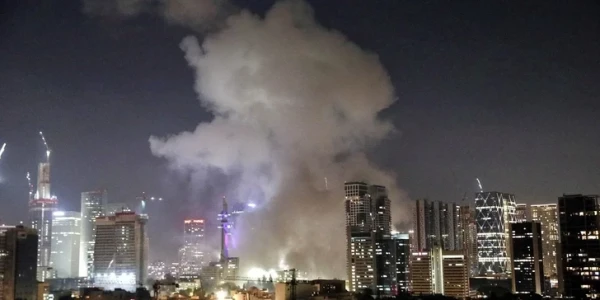
A total blackout is Tehran's weapon.
Iran has stated its readiness to respond to possible U.S. strikes on its energy infrastructure with a massive blackout in the Gulf countries. This will also affect the operation of desalination plants in the region.
In his often contradictory statements, Trump threatened to strike Iran's energy sector if Tehran did not open the Strait of Hormuz to all vessels. Iran promised that even after a "minor strike" on its energy sector, it would cause a total blackout in the Persian Gulf. Until that moment, Iran had implemented all its retaliatory actions against aggression from the coalition of Israel and the U.S. Apparently, after assessing the threat to the region in the event of a retaliatory Iranian strike, the U.S. paused its plans to bomb Tehran's energy infrastructure.
A representative of the "Khatam al-Anbia" headquarters, Ebrahim Zolfaghari, told the Mehr agency that in response, energy infrastructure, information systems, and desalination facilities could come under attack. A map indicating energy facilities in the Gulf countries was attached to Zolfaghari's statement. On it, thermal power plants in the region were marked as targets that would be subjected to retaliatory strikes. The thermal power plants in the Persian Gulf are crucial not only for the region's electricity supply but also for the operation of desalination plants that provide up to 99% of drinking water.
There are at least 17 key thermal power plants on the coast opposite Iran. Of these, eight were designated by Ebrahim Zolfaghari as legitimate targets.
-
Jubail Thermal Power Plant: one of the largest energy complexes in Saudi Arabia, located in the industrial city of Al Jubail. The plant plays an important role in supplying electricity and water to the eastern regions of the country, where a significant portion of the petrochemical industry is concentrated.
-
Dammam Thermal Power Plant: like Jubail, this is a key facility in Saudi Arabia's energy system, located in the city of Dammam. The plant supplies electricity to densely populated areas and the industrial sector in the eastern part of the country. Like other plants in the region, it is integrated with desalination facilities that provide a significant portion of drinking water.
-
Ras Laffan Thermal Power Plant: a major energy facility in Qatar, located in the Ras Laffan industrial area. The plant is part of the infrastructure of one of the country's key energy hubs, supplying electricity to industrial enterprises and residential areas. The complex is closely linked to liquefied natural gas production and the desalination system.
4-5) Ras Abu Fontas and Umm al-Houl Thermal Power Plants: among the main energy facilities in Qatar, located in the respective areas. The plants supply electricity to the capital region and surrounding areas. The complexes are integrated with desalination facilities that produce a significant portion of drinking water.
-
Salwa Thermal Power Plant: an energy facility on the border of Saudi Arabia and Qatar. The plant is part of the power supply system for border areas and provides electricity to the region's infrastructure and desalination facilities.
-
Al Mirfa Thermal Power Plant: a large energy complex in the United Arab Emirates, located in the emirate of Abu Dhabi on the coast of the Persian Gulf. The plant plays an important role in supplying electricity and water to coastal cities and industrial zones in the region. The complex is integrated with desalination facilities.
-
Jebel Ali Thermal Power Plant: one of the largest power plants in the UAE, located in the Jebel Ali area. The complex supplies electricity to the capital region and industrial zones, including port facilities and industrial parks. The plant is integrated with desalination facilities.
Iran's armed forces are capable of attacking coastal thermal power plants with both missiles and drones. Experts suggest that in the event of U.S. strikes and Iranian retaliatory actions, there may be water shortages and mass panic in several Gulf countries. Retired U.S. Army Colonel Daniel Davis stated to the media that the exchange of threats indicates a lack of a well-thought-out strategy and could lead to further escalation of the conflict.









Leave a comment