We are witnessing the disintegration of a common language.
Heidi Reichinnek significantly contributed to the unexpected rise in popularity of the Left Party in Germany. After the departure of the charismatic Sahra Wagenknecht and her entourage, the party seemed like a lame duck that would be devoured by political foxes. However, last year, the party regained its spirit and gathered support percentages. Without Heidi, this would hardly have happened. But for how long? And what could ultimately dismantle the two-cable Die Linke, the resilient successor of the GDR's SED? The reason is the "Jewish question." Or the "Palestinian question" — whichever you prefer.
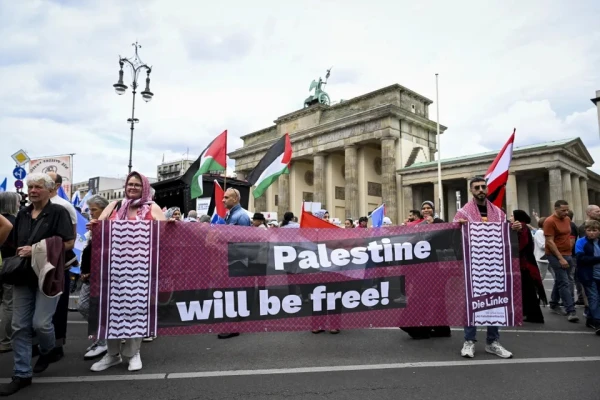
The conflict flared up again due to the notorious decision of the party's regional branch (Lower Saxony). They sharply criticized "modern Zionism," accused Israel of "genocide" and "apartheid." This predictably provoked not only criticism from other parties and accusations of anti-Semitism from the public but also a scandal within the party itself.
Is the Situation Irreconcilable?
This is a story about the impossibility of a "centrist" position that Reichinnek is trying to maintain. The politician has found herself in a zone where language ceases to function.
The conflict in the Middle East — in its current form — is structured in such a way that any statement is immediately radicalized. Any attempt at clarification is perceived as evasion. Any qualification is seen as weakness.
And in this space, Reichinnek tries to speak "complexly." She talks about Israel's right to exist, the unacceptability of anti-Semitism, the suffering of Palestinians, and the necessity to distinguish between the state and the government. In other words, she is trying to break down the situation into manageable parts. In the traditional model of political behavior, this should constitute a moderate position.
But the problem is that the "normal situation" no longer exists. We are facing not just an intra-party conflict in Die Linke. We are witnessing the disintegration of a common language. And this is a more general phenomenon, although the Left seems particularly vulnerable to the logic of the activism that has recently gathered anxious German hearts under its banner.
Some participants in the discussion speak the language of moral accusation. Others speak the language of historical guilt. Still others speak the language of human rights. And these languages no longer translate into one another. In this sense, Reichinnek's figure appears hopelessly old-fashioned. She tries to hold the space between positions — but that space is disappearing. Politics, in which "both-and" is possible, is being replaced by politics that requires "either-or." Either you are "for Israel." Or you are "for Palestine." Any third position is read as a hidden first or second. Moderation, which was once considered a sign of political maturity, is now perceived as evasion of responsibility. Complexity is seen as a lack of clarity. Caution is viewed as weakness.
As a result, a politician who tries to speak carefully finds herself in a worse position than someone who speaks radically. Because a radical position is clear. And a moderate one is suspicious. The Jewish-Palestinian issue is just one of the expressions that has heated up in Germany, especially on the left flank of the political spectrum. It seems this is the state of European politics in general. It is forced to respond to challenges from the East and West in this way. Perhaps this is inevitable — don’t we know this from ourselves, from the heated passions in Russian-speaking Facebook? There, mainly opponents of the Putin regime have gathered, but how differently they are motivated!
Moral conflicts have become so intense that they no longer allow for mediation. And then the very possibility of politics as the art of balance disappears. Only the articulation of camps remains.
Reichinnek is a figure of transitional times. An old-type politician in a new environment. A person who still tries to speak the language of differences in a world where differences are no longer accepted. And perhaps that is why she appears vulnerable.
Because today, it is not the one who expresses extremity who is vulnerable, but the one who tries to avoid it. Reichinnek is on a melting ice floe. And she is not alone, by the way. This is no longer the "Jewish question" as such. This is global bitterness — what did you expect?