
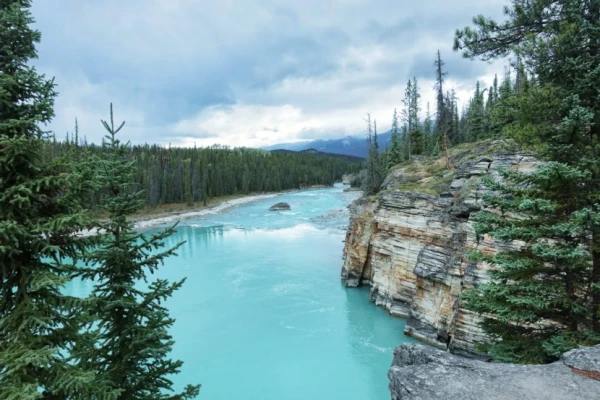
Residents are convinced that the federal authorities not only neglect them but also discriminate against them.
Since the beginning of January, there has been unusual activity in the Canadian province of Alberta. Despite the frost, hundreds of people are lining up at community centers to sign a petition from the Alberta Prosperity Project. The campaign organizers need to attract 177,000 people. If they succeed, local authorities will have to organize a referendum, and voters will have to answer the crucial question: should Alberta leave Canada?
Alberta is a region in western Canada that borders the United States. In terms of area (661,000 sq. km) and population (5 million people), it ranks fourth among all provinces in the country.
Alberta also makes a significant contribution to the country's economy. It accounts for about 15% of Canada's GDP. Only the capital province of Ontario and Quebec contribute more. However, in terms of GDP per capita, Alberta is far ahead of the rest of Canada. For this reason, as well as because the local economy is based on oil and gas, Alberta is rightly considered a driver of the Canadian economy.
Culturally, the residents of Alberta also feel distinct from their fellow citizens living in the eastern part of the country. There is a widespread belief that in terms of mentality, they align more with typical Americans, characterized by individualism and conservatism. This is partly due to close trade ties with the U.S., to which Alberta exports oil. It is also due to the distance from Ottawa, Quebec, and Toronto, which de facto shape their economic space.
The differences between Alberta and other provinces are clearly visible on all electoral maps. While all of Canada votes for the Liberals, Albertans exclusively support the Conservatives in every election. This undoubtedly affects their worldview.
Economic and political factors are an integral part of Alberta's separatism, which has periodically resurfaced since Canada gained independence. Proponents of independence feel neglected by the central government: in their view, Alberta contributes significantly to the federal budget, helps support other provinces, and receives almost nothing in return.
The issue of unfair redistribution of national wealth becomes particularly acute whenever the Liberals come to power in Ottawa. Their attempts to regulate the oil industry lead Alberta residents to believe that the federal authorities not only neglect them but also discriminate in favor of the more populous eastern provinces. This phenomenon has been around for decades and even has its own name – "Western Alienation."
In this sense, it is symptomatic that over the past 50 years, separatism in Alberta has experienced two surges. Both coincided with the rule of the Trudeau family. In the 1980s, Liberal Prime Minister Pierre Trudeau introduced a 25% tax on Alberta oil, which devastated the local industry and led to a sharp rise in unemployment. His son Justin came to power in 2015 – Alberta residents were dissatisfied with his climate change policies, including the introduction of a carbon tax and investments in clean energy.
During Justin Trudeau's era, the most prominent manifestation of Canadian separatism was the Wexit campaign, which encompassed not only Alberta but all of Canada's western provinces. The movement transformed into a political party of the same name; however, it did not achieve significant electoral success at either the local or federal level.
Discussions about Alberta's secession flared up again in 2025. This time, the trigger was purely political reasons: the long-despised Justin Trudeau finally resigned, yet his Liberal party unexpectedly remained in power and formed a new government, this time led by Mark Carney. The Liberals owed this outcome to the eastern provinces, which were outraged by Donald Trump's threats to annex Canada. Meanwhile, the conservative west, which had hoped for change, was left empty-handed.
The discontent was so strong that almost immediately after the elections, the Alberta government acknowledged that it could no longer ignore the fact that the local electorate was fed up with Ottawa's oil restrictions. Provincial Premier Danielle Smith stated that she personally was against separation. At the same time, the politician announced an electoral reform ("Bill 54"), which significantly eased the process of conducting referendums.
This was immediately seized upon by the separatist organization Alberta Prosperity Project, which requested a referendum. In June, its leader Mitch Sylvester officially presented the initiative to the local election commission. However, the commission decided to take its time and redirected the document to the court, which was to check its compliance with the Canadian constitution. The consideration lasted until December, and the Alberta court's decision was negative.
However, the story did not end there. Less than a week later, the province's legislative body effectively annulled the results of the court's legal assessment. Alberta Prosperity Project requested a referendum again with a slightly modified wording of the question, after which the local election commission officially gave it the green light. According to provincial laws, the signature collection that started on January 3 will last until May 2. If successful, the referendum will take place in 2027 – simultaneously with the Alberta parliamentary elections.
Even if the Alberta separatists manage to gather signatures for the referendum, it is far from certain that the vote itself will be successful. In reality, the number of supporters of Alberta's independence is relatively small. According to various sociological surveys, this idea is supported by 20 to 30% of the province's residents. Meanwhile, 70% or more, on the contrary, want to remain part of Canada.
Simultaneously with the launch of the Alberta Prosperity Project campaign in 2025, another organization – Keeping Alberta Forever Canadian – became active. The name speaks for itself: under its banner, supporters of Canadian unity have gathered. They also requested and submitted a petition for a referendum to the local government, albeit with a diametrically opposed question: should Alberta remain part of Canada? Unlike the separatists, there were no legal issues with this petition. The movement managed to conduct a signature collection in 2025, ultimately supported by 404,000 voters out of the 293,000 required.
Theoretically, Keeping Alberta Forever Canadian can now hold its own referendum. However, the movement's leader, former Alberta Deputy Premier Thomas Lukaszuk, sees no point in this. In his opinion, the signature collection is needed so that the provincial authorities are aware of the real sentiments of the majority of voters.
It remains unclear whether the separatists will be able to repeat or even surpass the record of their opponents. There is a buzz at the local signature collection points. People speaking to the press are willing to stand in line for hours just to end the "abusive relationship" with Ottawa. However, the campaign is still in its early stages. The success or failure will become clear by the end of spring.











Leave a comment