
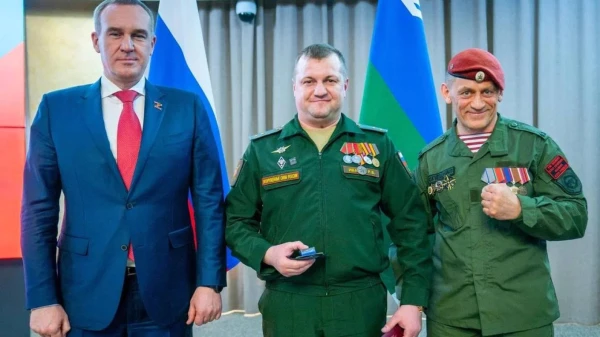
The most obvious solution now is to open more decorative, agitprop, and clownish positions for them.
Veterans of the war against Ukraine are not the kind of people from whom leadership emerges in Russia. The general public is not particularly pleased to see them in civilian life either. However, the regime is ready to organize propaganda and decorative sinecures for them in unlimited quantities, writes The Moscow Times portal.
Putin constantly repeats that participants of the war against Ukraine are supposedly becoming the 'new elite' of the Russian Federation.
A bad beginning is half the battle. I do not know if he is truly hurrying to bring the moment closer when battle-hardened veterans will surround him as court bankers and oligarchs, captains of industry, and governors of regions. But the loyal media are overflowing with praise:
Veterans of the special operation, upon entering government service, are forming a new type of governance. They immediately move from words to deeds, propose fresh ideas, and tackle long-standing problems... The veterans themselves come from the people and are well aware of the real demands. These individuals have already proven their loyalty to the Motherland on the front lines and are ready to serve the country in civilian life...
In September of last year, over a thousand participants of the 'SVO' received mandates in the 'elections' held in the regions. This means about 2% of the fifty thousand positions contested at this event. Mostly minor and very minor deputy posts at the local level. But still, a bad beginning is half the battle.
That is quite a lot, considering that the mass return of veterans to civilian life is just beginning. The authorities do not disclose how many such retirees there are today, but six months ago they announced that there were only 137,000 at that time.
There are currently about 700,000 people in the Russian military grouping. The number of wounded, many of whom are subject to demobilization, is clearly no less. And some of those whose contracts have expired are not continuing their service. This means that the arrival of many hundreds of thousands of candidates for 'elite' status, and eventually even millions, is still ahead.
Warm places are already being prepared for them. This autumn, 'elections' to the State Duma are upcoming. Initially, 150 seats were reserved for 'SVO' fighters, i.e., one-third, but the poor suitability of the available material seems to have forced a reduction of the plan by about half, if not more. But even so, veteran votes will still be enough to give the Duma choir a new tone.
And they are not only preparing to place them in the Duma. A special program called 'Time of Heroes' has been opened for the placement of deserving fighters in warm positions.
Regime officials, including high-minded experts from the Higher School of Economics and TsMAKP, predict that demobilized fighters will discover a taste for entrepreneurship, prudent management, and even settling desolate lands. Starting January 1, they will receive decent money to open or develop their businesses.
Only in comparison with these expectations is the awkwardness caused in bureaucratic circles by the VTsIOM survey about the public's attitude towards demobilizing veterans understandable.
Although the survey was ordered by the authorities themselves, and the polling service carried it out with sincere efforts to please, the quasi-legendary 'Free Press' titled its article: 'VTsIOM Provoked with Its Questions.'
And it was right.
It sounds like a hint. 'The wording of the questions sows dangerous seeds of doubt in our society,' is the diagnosis of the 'Free Press,' and one cannot really argue with that.
'Imagine a situation: you are working and a new employee, a veteran of the SVO, has joined your team. How would you perceive this?'
The Russian public is cowardly, and 59% of respondents answered that they would perceive it rather positively. But 33% of respondents dared to report a neutral attitude, while the rest said they would respond negatively or did not know. Among the youth, the proportions flipped: 64% of this group reported a neutral attitude, while only 30% reported a positive one.
This sounds like a hint that a veteran of the 'SVO,' with his peculiarities and special privileges, will not bring joy to new colleagues. The authorities clearly expected much more obedience from their subjects.
Irritation was apparently also caused by the responses to the 'open' (i.e., without prompts) question about in which field the experience of SVO fighters would be useful to them in civilian life. The security sector (army, law enforcement, police, Rosgvardiya, etc.) confidently took the top spot. It was chosen for veterans by 40% of respondents.
Conditionally speaking, pedagogy ('military-patriotic education' and other similar topics) was offered by 21% of the public.
However, 'public administration' (including clownish deputy positions) was deemed suitable for them by only 12% of respondents. And business — literally no one.
Ordinary Russians see the returning heroes as policemen, informers, security guards, prison guards, as well as those leading 'lessons of courage' and 'conversations about important matters.' But they clearly do not wish to see them as their bosses. Or even simply as colleagues in 'ordinary' work. Just like merchants who will sell them cucumbers or fix their cars.
Apparently, they expect different skills from them.
Not everyone can be veterans. And then we come to the most interesting part. Is the 'elite' ready to open its ranks and let in at least some deserving fighters?
It is important to note that the tradition of incorporating military veterans simply because they are veterans does not exist and has never existed among the Soviet-Russian nomenklatura. Even veterans of wars that, unlike the current one, were unanimously recognized as just.
In the U.S., almost all presidents who held this office from the late 1940s to the early 1990s served in the army or navy during World War II. Dwight Eisenhower was a commander in Europe. John Kennedy, Gerald Ford, and George H.W. Bush were combat officers. Lyndon Johnson, Richard Nixon, and Ronald Reagan did not see combat but were in military service.
Over the same forty years, about 40 members and candidates of the Politburo were born during the draft years in the USSR during the war with Germany. Half of them did not serve at all during the war (Suslov, Gromyko, Podgorny, Kirilenko, Andropov, Chernenko, Ligachev), but did not feel any hindrance in their subsequent career.
Some of them were allowed, with varying degrees of radicalism, to falsify the milestones of their then-path. 'He ran to the front three times, but each time he was returned,' is reassuringly stated in the official biography of one such dignitary.
As for the other half of the Politburo that served, if we exclude the career military personnel who were in the Politburo as heads of their respective departments (Zhukov, Grechko); quite civilian, albeit with general's epaulettes, captains of the military-industrial complex (Ustinov); and party dignitaries who were temporarily transferred to high-ranking political workers during the war (Khrushchev, Brezhnev), only three true front-line soldiers remain: Pyotr Masherov (party governor of Belarus in the 1960s-1970s), Viktor Chebrikov (KGB chairman in the 1980s), and Alexander Yakovlev, the ideologist of perestroika.
Not from the layers from which leadership emerges. As we can see, the proportion of real front-line soldiers among Politburo members was even lower than the proportion of front-line soldiers among 'ordinary' Soviet men of the same age categories. This pattern was observed at lower nomenklatura levels as well. The logic of the imperial bureaucratic apparatus (excluding law enforcement agencies) did not imply accelerated advancement for military heroes. They had to climb the ranks on common grounds.
And later, veterans of the Afghan and Chechen wars achieved no successes, except for brief ones, outside of law enforcement agencies. The attempts of Generals Lebed, Rokhlin, and Shamanov to make a political career were unsuccessful, although not as dramatic as later with Prigozhin.
The instincts of today's nomenklatura remain, of course, the same. It will close ranks in front of any competitors, even the most respected ones. And veterans of the war with Ukraine are not nearly as respected as veterans of the war with Germany. And they are certainly not from the layers from which leadership emerges in Russia. Such individuals rise to the top only if there is a revolution. And in fear of it, the nomenklatura and Putin are united.
Therefore, let’s take a closer look at the only veteran of the 'SVO' whom Putin appointed to a prominent position — Tambov Governor Yevgeny Pervyshov. He is being promoted as a new candidate elevated for his exploits and as the first swallow paving the way up for his fellow fighters.
In reality, however, Pervyshov is not a brother to the fighters, nor is he a fighter at all. He is a banal Krasnodar nomenklaturist who has spent twenty years in his region in leadership positions, served five years as the mayor of Krasnodar, and then stumbled and languished as a deputy in the Duma.
And then the war! He portrayed a departure for military service, spent several months in a safe drone brigade 'BARS “Cascade”' organized specifically for nomenklaturists, emerged from there as a veteran, went through the 'Time of Heroes' program in this capacity, and received a position in Tambov from Putin. Here you have a typical representative of the 'new elite.'
Can they repeat it? The relabeling and transformation of the 'old elite' into the 'new' is happening not only in the respectable 'Cascade' but also at the level of absurd yet persistently spread fakes — about the fictitious service of the son of Putin's press secretary Peskov-Choulza with Prigozhin or the alleged concussion of Putin's daughter Vorontsova, who supposedly headed a non-existent hospital.
This includes the posing of propagandist Solovyov, dressed in uniform, helmet, and bulletproof vest, supposedly near the front line. And entertainment trips to the conquered lands by 'cultural figures.'
All this speaks volumes about the highly developed ability of the 'old elite' to change their external appearance and nothing about the chances of genuine fighters of the 'SVO' to truly become the 'new elite.'
Participants of the 'SVO' are unlikely to simply dissolve or join mafia or semi-mafia organizations, as was the case with the 'Afghans.' They are far more numerous, and, importantly, the regime is promoting them as true heroes, much like the Brezhnev regime once promoted participants of the war with Germany.
Apparently, something similar will be attempted this time as well. With the difference that the cautious Brezhnev launched the cult of veterans only a quarter of a century after that war, when they no longer aspired to careers.
From the current veterans, especially with Putin's praises, it will not be so easy to get rid of them.
The most obvious solution now is to open more decorative, agitprop, and clownish positions for them — in the 'parliament,' 'parties,' institutions, universities, and schools. Let them give speeches, reminisce about the past, and teach the youth traditional values and patriotism.
The atmosphere will become even more stifling, but that is precisely what the regime wants. And important positions are presumably to remain in the same hands. And this is again what the nomenklatura instinctively reaches for. For this, they are ready to don epaulettes and disguise themselves as veterans.
Such is today’s de facto 'Putin's plan,' whether it will work or not. The regime does not intend to give its retired mercenaries too much, but is not sure it can keep them within the frameworks it has devised for them. It has already failed to hold onto the Prigozhinites.
Hence the nervousness at any hint that ordinary people also fear the SVO participants and do not quite believe in the spectacle that the authorities are preparing for them.


Leave a comment