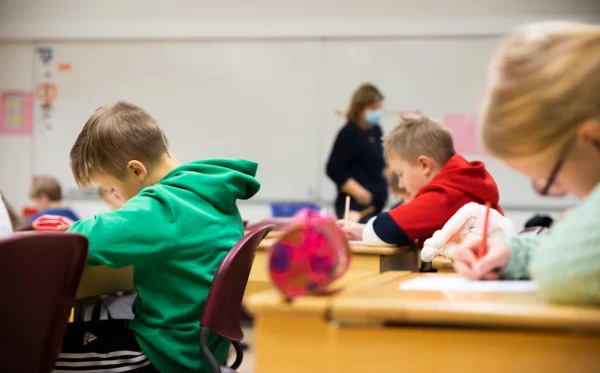
The example of tolerance from the teacher contributes to tolerant behavior among children.
The Finnish publication Yle reported on a case at the Swedish-speaking Storen school in Espoo, where a Ukrainian girl refused to sing "Kalinka" in music class, but the teacher insisted that everyone should participate in the singing. The school administration and representatives of the Education Department stated that the teaching was in accordance with the fundamentals of the curriculum, but emphasized the importance of flexibility and understanding from the teacher in such situations.
Yle's editorial team found out how elements of Russian culture are perceived in different schools in Finland. Out of 17 schools randomly selected from various parts of the country, only three responded to Yle's questions. Additionally, journalists contacted the publishing house Schildts & Söderströms, which published the textbook used at Storen school, as well as Otava — the only publishing house currently publishing music textbooks for general education schools.
According to Juhani Juvonen, a music teacher at the Länsi-Puijo school in Kuopio, many Russian songs have seeped into Finland due to the close proximity of the countries. He stated that they can be heard not only in schools but also on the radio, as they have become part of the hit culture (iskelmä): for example, translated into Finnish and performed by local musicians Uralin pihlaja ("Ural Rowan") and Moskovan valot ("Moscow Lights").
The teacher emphasizes that he is completely against the actions that Russia is currently taking as a state.
– But Russian culture has not disappeared and will never disappear from Finland. These songs are sung here, and children love it when I play them on the accordion. They are wonderful melodies that Ukrainian children in my class enjoy singing when I perform Minä soitan harmonikkaa ("I play the accordion") on the piano for someone's birthday – they really like it.
According to Juvonen, it would also be worth paying attention to American and Israeli songs in the educational program, as both countries have also shown aggression towards other states in recent decades. At the same time, he notes that it is important to consider the content of songs in each case separately, as not all of them are related to politics.
"We respect all cultures" The principal of Myllymäki school in Lappeenranta, Maija Pasenius, notes that teaching is conducted according to the pedagogical plan: children learn about the history of music, sing, and play works from various genres and peoples of the world.
If an assignment contradicts the values or beliefs of a student, an alternative is always offered. The principal also emphasizes that there are many children with Russian roots in South Karelia, and their origin should not serve as a reason to oppress them.
– It is important to remember that the events in the world are not the fault of any child. Therefore, we respect all cultures. We want everyone to feel safe and valued.
"It is important for the teacher to be sensitive and able to understand the student's state"
The principal of Kaarisilta school in Pori, Johanna Siitari, notes that Russia is a neighbor of Finland with a rich cultural heritage. She points out that the rapidly changing political situation requires schools to be flexible and culturally sensitive.
– It is important for the teacher to be sensitive and able to understand the student's state.
According to her, military history is discussed in the upper grades, which can be a heavy topic even for Finns. Music teacher Mari Gökcheviran notes that in their school, the war is discussed if the children bring it up themselves, and the multicultural environment makes such conversations safe.
According to her, the example of tolerance from the teacher contributes to tolerant behavior among children.
– We have many Ukrainian and Russian children, and they sit calmly next to each other in class. Children are quite tolerant if adults accept and help them.
Publishers are responsible for the content of textbooks, while teachers are responsible for their use. At Storen school in Espoo, an old textbook Da Capo from Schildts & Söderström was used. The executive director of S&S, Nils Saramo, noted that the Da Capo series was compiled about 20 years ago. It includes, among other things, the Russian song "Kalinka."
– All educational materials reflect their era and depict the social climate of that time. At that time, the situation in the world was different than it is today. This has probably reflected to some extent on the structure of this textbook. Today, the choice would probably be somewhat different.
He added that culture has its own value outside of politics, and great composers remain significant even in tense times.
Since 1992, publishers have been responsible for the content of textbooks, not the Education Department, while teachers are responsible for the selection and use of educational materials in schools.
Currently, only the publishing house Otava publishes music textbooks for general education schools, while others have ceased their publication. According to the publishers, this is due to the difficulties of publishing music textbooks specifically: it is necessary to pay royalties for compositions for printed and electronic versions, and musical trends and preferences of youth change so quickly that expert groups cannot prepare fully relevant editions in time.
However, the use of old textbooks in schools is not only related to publishing difficulties. Many schools prefer not to spend money on new books if the old ones meet the curriculum.
The publishing house Otava continues to publish music teaching materials Saa laulaa!, intended for primary school. There have been no significant changes to them in recent years. According to Anna-Reeta Sipilä, the director of primary school textbook content, the publishing house monitors changes in society and evaluates materials based on the values outlined in the curriculum. Educational materials should reflect the changing situation and present elements of different cultures analytically and from different perspectives, so that children develop a deeper understanding of the diversity in the world.