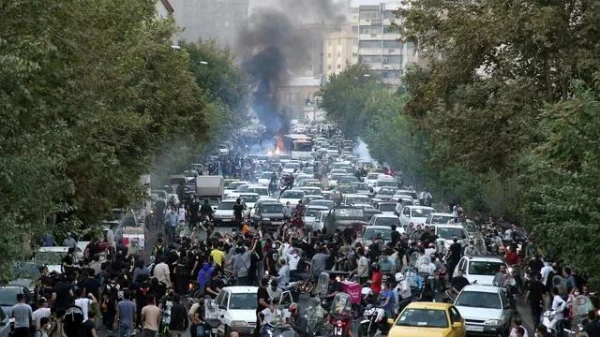
In Iran, protests have continued for the fifth day, sparked by a severe economic situation and high inflation. Media and human rights activists report the first casualties during the demonstrations. Among the dead may be a security officer.
In Iran, during the ongoing protests related to the tense economic situation, which have lasted for five days, at least six people have died. This was reported by the American agency Associated Press on the evening of Thursday, January 1. Information about the first casualties of the demonstrations was also disseminated by the Reuters agency, citing local media and human rights organizations, but without specifying the number of dead.
According to the Iranian news agency Fars and the human rights group Hengaw, several fatalities have been recorded in the city of Lordegan in southwestern Iran. Another person reportedly died in Isfahan province in the central part of the country.
On January 1, state television of the Islamic Republic reported that a member of the paramilitary Basij was killed in the city of Kuhdasht in the western Iranian province of Lorestan. The Islamic Revolutionary Guard Corps (IRGC) accused the demonstrators of his death. The human rights organization Hengaw claims that the deceased was a protester killed by security forces.
Mass protests in Iran
Protests in Iran began on December 28. On that day in Tehran, shop owners - first those selling mobile phones, and then others - closed their stores in protest against the worsening economic situation in the country. Later, residents of other major cities joined the protests.
On December 30, reports emerged of the first clashes between protesters and police, and that security forces used tear gas. As noted by the dpa agency, the protest soon turned political: its participants began to chant slogans such as "Death to the dictator" and "Long live the king." The former may refer to Iran's spiritual leader Ayatollah Ali Khamenei. The latter seemingly calls for the restoration of the monarchy led by the Shah, which was overthrown in Iran during the Islamic Revolution of 1978-1979.
Iranian security forces urge citizens not to protest
On December 30, Iranian President Masoud Pezeshkian announced that he had instructed the Minister of Interior to engage in dialogue with representatives of the protesters and trade unions to "listen to their legitimate demands." Iranian security forces stated there was a "conspiracy involving external enemies" aimed at provoking unrest in the country and urged citizens not to participate in it. On January 1, local media reported that 30 people were arrested in Tehran for "disturbing public order."
The Iranian economy is suffering from 40% inflation and Western sanctions related to the government's nuclear program. President Pezeshkian promised to combat inflation and the high cost of living.