
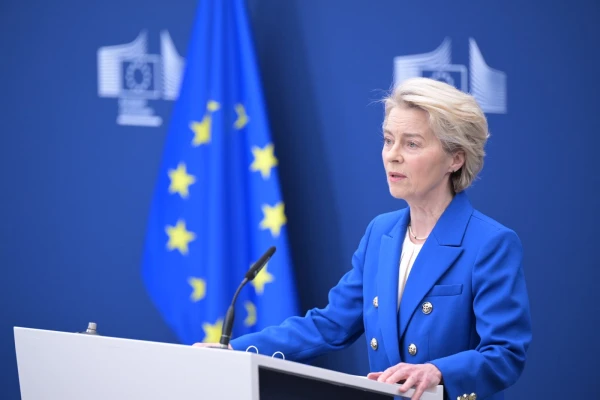
EU leaders and a number of European countries expressed confidence at the beginning of the summit in Brussels that an agreement would be reached on the use of frozen Russian assets for a "reparations loan" to Ukraine.
The EU summit regarding the possible use of frozen Russian assets to assist Ukraine began in Brussels on Thursday, December 18. Before its opening, the leaders of the European Union and most participating countries stated the need to adopt the European Commission's plan. "We will not leave the European summit until we resolve the issue of financing Ukraine," said European Commission President Ursula von der Leyen to reporters on the morning of Thursday, December 18.
At the same time, she expressed understanding for the position of Belgium and several other countries that demand to share the financial risks when using frozen Russian funds. She urged Europeans to agree on the risk-sharing among all countries in case the blocked assets are used for a "reparations loan" to Kyiv.
Kallas: Putin is counting on the failure of the initiative regarding Russian assets
For her part, the EU's High Representative for Foreign Affairs and Security Policy, Kaja Kallas, emphasized that Russia shows no willingness for serious negotiations for peace in Ukraine. "Even the proposal for a ceasefire at Christmas was rejected. Clearly, we need to put pressure on Russia to stop pretending to negotiate and actually start doing so," she stated in a statement published on the European external action service's website.
The head of European diplomacy emphasized that Brussels is ready to consider Belgium's concerns and distribute risks among all countries. She called for a corresponding decision, as Russian President Vladimir Putin "is counting on the failure" of these efforts.
Tusk: A simple choice - money today or blood tomorrow
Meanwhile, Polish Prime Minister Donald Tusk, upon arriving in Brussels, reminded that the decision on further support for Ukraine is crucial for the security of all Europe. "Now we face a simple choice - either money today or blood tomorrow. And I am not just talking about Ukraine, I am talking about Europe. And this is our decision that we must make, and only ours," he told reporters. Tusk urged all European leaders to support this decision.
German Chancellor Friedrich Merz expressed confidence in the possibility of reaching an agreement on the use of Russian money. "I see no better option," he stated before the start of the EU summit in Brussels. The day before, speaking with a government statement in the Bundestag, Merz emphasized that this decision should send a signal to Moscow about the futility of continuing the war, as resources in Kyiv will not run out. Merz also called the decision on Russian assets a test of Europe's sovereignty. "We will not be a pawn in the game of great powers," he said, hinting at the US and Russia.
French President Emmanuel Macron also expressed confidence in the success of the initiative. "We will find a unified position at the summit regarding military support for Ukraine," he indicated, adding that Europeans have a common readiness to make such a decision.
Orban: The idea of using Russian assets is "dead"
Meanwhile, the head of the Belgian government, Bart De Wever, reiterated the need to consider his country's concerns, as a large portion of the frozen Russian assets - about 183 billion euros - is held in the Belgian depository Euroclear. "Belgium will not approve a decision where we are the only ones bearing both the risks and the responsibilities," he noted.
Hungarian Prime Minister Viktor Orban, in turn, called the idea of using frozen state assets of Russia "dead." According to him, there is no chance of adopting this decision, as a number of EU countries oppose it - enough to block it. "Using Russian assets would be tantamount to declaring war," he stated before the start of the summit in Brussels. Orban added that any agreement on debt obligations requires approval from the Hungarian parliament, which is impossible at this time "and probably never will be."
The European Commission insists on adopting the plan for a loan to Ukraine
Summit participants will discuss a complex scheme for lending to Kyiv proposed by the European Commission. It involves using frozen Russian assets for a "reparations loan" to Ukraine, as well as providing national guarantees from EU states. The return of money to Russia will only be possible if it pays reparations to Ukraine after the war ends.
The EU Council on December 12 temporarily banned the transfer of funds from frozen assets back to Russia. The ban will remain in effect as long as the actions of Russia in the context of the war "pose a risk of further serious deterioration of the economic situation" in the EU. On the same day, the Central Bank of Russia filed a lawsuit against Euroclear in the Moscow court.
Earlier, Germany and other EU countries decided by a majority vote to impose an indefinite ban on the return of Russia's funds frozen in the EU. This step will allow EU countries not to vote on the issue of asset freezing every six months, as had been the case until now.





Leave a comment