
For over a hundred years, frequency stabilization in power grids at the level of 50 Hz, maintaining stable power, and compensating for reactive power to reduce losses have traditionally and largely been ensured by the mechanical inertia of heavy rotors in generators at coal and gas power plants.
All of this has its roots in fossil fuel-based electricity generation.
Germany has become the first country in the world to adopt a new principle for stabilizing the operational characteristics of power grids. More precisely, it has taken a step in this direction by launching a power grid stabilization system based on supercapacitors.
Instead of a noisy and large machine hall acting as a synchronous compensator, a relatively small, quiet, and clean room with a STATCOM (Static Synchronous Compensator) module and racks of supercapacitors, each resembling a soda can, has taken its place.
The first such compensator is connected to the grid at a substation in the Merum area (Lower Saxony). The project has been implemented by Siemens Energy (developer of the SVC Plus FS technology) and TenneT (the electricity transmission system operator). The system is currently undergoing testing and will soon enter commercial operation. This innovative solution took more than ten years to develop, with about three years for construction.
The technology uses supercapacitors instead of traditional batteries and the mechanical inertia of flywheels. Due to their properties, they can provide instantaneous high power output to the power grid within milliseconds, compensating for frequency deviations and reactive power. Essentially, this creates artificial inertia in the grid, replacing traditional mechanisms for power and frequency compensation, such as the regulated speed of generator shafts in coal or gas power plants. Moreover, the system operates effectively in automatic mode with remote monitoring and diagnostics.
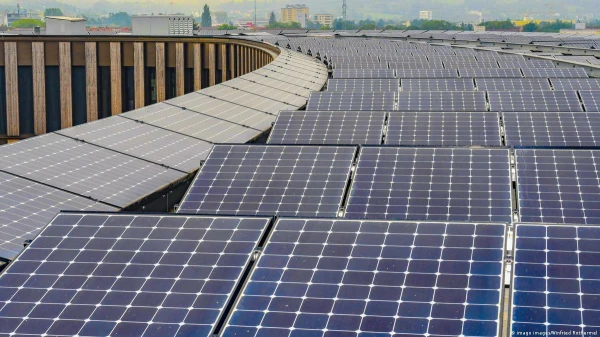
All this innovation did not arise by chance. In Germany, there is a high share of generation from solar panels, which, along with their inverters, are physically unable to provide compensatory mechanisms. At the same time, there is an intensive closure of coal and gas power plants, which deprives national power grids of traditional methods for compensating frequency deviations and maintaining load.
It is no coincidence that the project in Merum is based on the site of a closed coal power plant. It will organically replace the decommissioned generators with a new, modern, and clean compensation mechanism based on supercapacitors. Which of these will prove to be more reliable is still an open question: a couple of noisy and bulky generators or thousands and thousands of supercapacitors housed in several racks.
It is expected that up to 30 such compensation substations based on supercapacitors will be required for the normal operation of power grids in Germany. At least, this is the number planned by the network operator TenneT.














Leave a comment