
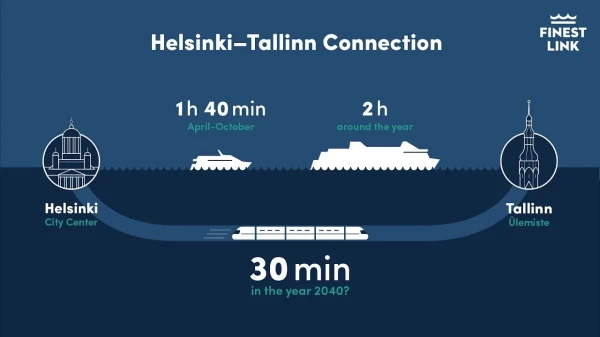
Helsinki Mayor Daniel Sazonov, who took office in June 2025, advocates for the construction of a railway tunnel connecting the capital of Finland with the capital of Estonia, reports Postimees and uudenmaanliitto.fi.
He notes that Finland has been sidelined in the development of the European railway network in recent years and believes that the tunnel is necessary primarily for connecting through Tallinn to European railways, for example, to the Rail Baltica line leading to Warsaw.
Sazonov proposes to lay underwater railway tunnels by 2060 that will connect the country with two neighboring states. This will open new opportunities for logistics, passenger, and freight transportation.
FinEst Link is a research project that explores the possibility of underwater railway connectivity between Helsinki and Tallinn across the Gulf of Finland. From 2016 to 2018, a consortium including Finnish and Estonian entities conducted a feasibility study.
According to the results, the implementation of the tunnel is technically feasible, including the construction of two tunnels (for passenger and freight trains), as well as the potential construction of two artificial islands and new terminals on both sides of the gulf.
The total length of the tunnel is estimated to be about 100-103 km, making it one of the longest underwater railway tunnels in the world.
Traveling by train between Helsinki and Tallinn would take about 30 minutes, compared to 1.5-2 hours by ferry. The construction cost is estimated to be in the range of 13-20 billion euros. The figure of 16 billion euros is referred to as the most "average" reference.
It is projected that the tunnel could serve up to 23 million passengers a year—significantly more than the current ferry statistics. The project also envisions freight services: according to estimates, freight volumes could significantly increase compared to the current level.
In addition to transportation benefits, economic advantages are also expected: the creation of a unified metropolitan region, increased employment, and enhanced economic activity and logistics connections.
Despite the successful completion of the feasibility study, the authorities of Finland and Estonia have not confirmed the start of construction to date. The Finnish Ministry of Transport notes in a statement that there is currently no official public project.
Nevertheless, the project is still considered promising, and discussions—both in Estonia and Finland—continue.
Support for the initiative from the Mayor of Helsinki adds political strength and relevance to the project. If things develop favorably—and funding is available—the tunnel could fundamentally change the transportation and economic landscape of the region. However, many "ifs" remain: if funding is found, if the parties agree, if technical and logistical challenges can be overcome.










Leave a comment