

Putin wished: "To encourage men to participate more actively in family responsibilities."
Measures taken to address demographic issues in Russia have proven insufficient, stated Russian President Vladimir Putin at a meeting of the Council for Strategic Development and National Projects.
"Unfortunately, the negative trend persists, and birth rates continue to decline," Putin noted. According to him, there are "objective reasons" at play, including "global demographic trends," external challenges, as well as the overlapping demographic waves of the mid and late 20th century, which are "making themselves felt again."
"Our long-term historical task is to preserve and multiply our people," Putin said, addressing officials and ministers. He urged to "intensify existing measures at all levels" to reverse the trend of declining birth rates.
Back in 2018, Putin set the goal of halting the natural decline of the population within six years, a challenge Russia faced shortly after the annexation of Crimea. However, despite the national project "Demography" costing 4 trillion rubles, the country lost 4 million people from 2016 to 2024 due to excess mortality over birth rates.
From 2014 to 2024, the number of births in Russia plummeted by a third, and last year it reached the lowest level since 1999 — 1.222 million infants. In the current year, the birth rate has decreased further by 4%, to 288.8 thousand children from January to March, setting anti-records for the last 200 years. In response, Rosstat has classified demographic statistics.
Last year, Putin again set the goal of achieving a slowdown in natural decline to zero by 2030. The targets of national projects also included a sharp increase in the total fertility rate (TFR, the average number of children per woman): by 2030 it should rise to 1.6, and by 2036 reach 1.8 — the highest since the late USSR.
To achieve this, within the framework of the "family-centered" strategy, officials intend to strengthen the institution of family and marriage, as well as promote "traditional family values": images of large families are planned to be integrated into advertising and media content, and state awards are to be introduced for grandfathers and grandmothers with many grandchildren.
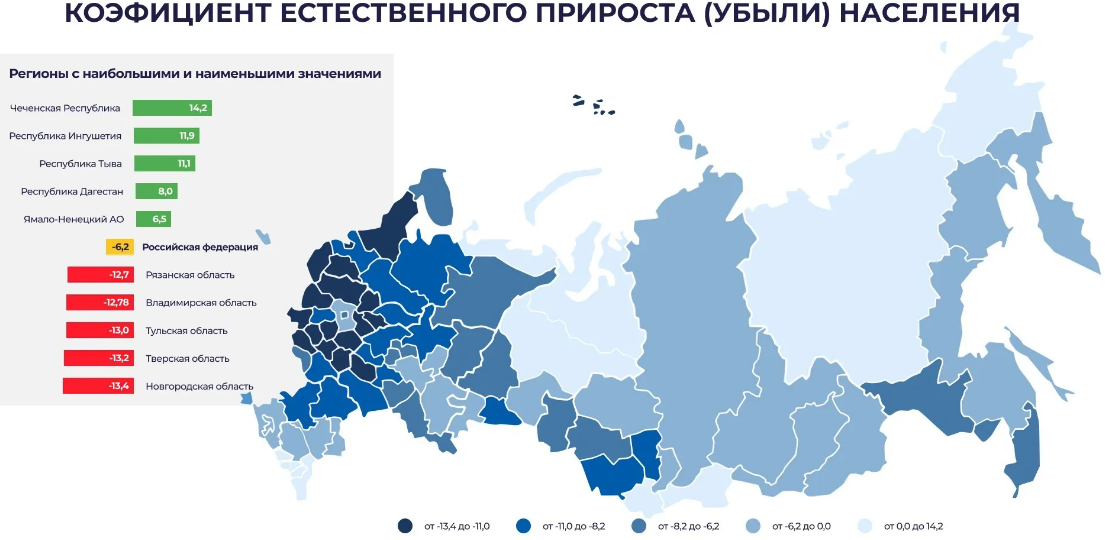
In the current year, the TFR in Russia has dropped to 1.376 — the lowest value since 2006. As of the end of 2024, this figure was 1.4, in 2023 it was 1.41, in 2022 it was 1.416, and in the pre-war 2021 it was 1.47. The decline in the total fertility rate has been recorded by official statistics for the 10th consecutive year, during which it has decreased by 0.386 points, or 22%.
According to Putin, to emerge from the demographic pit, it is worth considering "measures to support engaged fatherhood." "To encourage men to participate more actively in family responsibilities, in making decisions about having children, and to spend more time raising them, leading a healthy lifestyle and preserving reproductive health for as long as possible," the president explained.
Top 5 countries with the lowest birth rates:
Taiwan;
South Korea;
Singapore;
Ukraine;
Hong Kong.
Birth rates in Africa
Most countries with the highest birth rates are located in Africa. The average birth rate in sub-Saharan African countries is 4.6, the highest in the world. Niger leads with a rate of 6.8 children per woman, Somalia — 6, the Democratic Republic of the Congo and Mali — 5.8 each, and Chad — 5.6.
Birth rates in Asia
South Korea has the lowest birth rate in the world — 0.9 per woman, Puerto Rico — 1.0, Malta, Singapore, and Hong Kong SAR — 1.1 each.
The birth rates in China are 1.7 and in India — 2.2. In China, this situation was influenced by the "one-child policy," which the country adhered to from 1980 to 2016; in 2021, a law was passed allowing couples to have up to three children.
Birth rates in Europe
Birth rates in European countries do not exceed 2.0 anywhere. In recent years, the birth rate has been declining. Factors include socio-economic incentives to postpone childbirth, fewer desired children, lack of childcare, and changing gender roles.
Birth rates in the USA
The birth rate in the USA has been falling for several decades. The decline also occurred against the backdrop of the COVID-19 pandemic. In 2021, the fertility rate in the USA fell to a record low in history — 1.5.















Leave a comment