
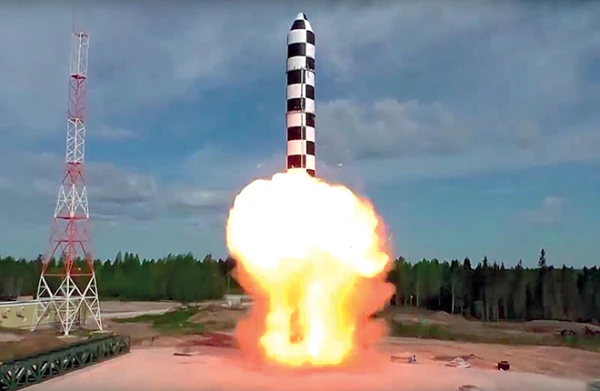
The new complex has been under development for 12 years, but has not yet been perfected.
The explosion at the strategic missile forces base in the city of Yasny, Orenburg region, which occurred on Friday afternoon, was the result of unsuccessful tests of the latest nuclear missile RS-28 "Sarmat," military experts believe.
In footage captured by eyewitnesses, the missile launches from the silo, ascends into the air, then tilts, catches fire, and falls apart, leaving behind a giant mushroom-shaped cloud of orange-purple hue.
A liquid-fueled intercontinental ballistic missile exploded near Orenburg, and all signs point to it being the "Sarmat," according to Pavel Podvig, a senior researcher at the UN Institute for Disarmament Research. This missile has been under development in Russia since 2013 to replace outdated Soviet land-based missiles. President Vladimir Putin promised that the "Sarmat" would enter service by 2020, but the missile has yet to fly. The previous attempt to test it about a year ago ended in failure: the missile exploded in the silo at the Plesetsk test site, leaving behind a giant crater.
It is most likely that the "Sarmat" tests have failed again, agrees Etienne Marcus, a researcher at the French Foundation for Strategic Research (FRS). The military urgently needs to certify the missile, as Putin announced its deployment in the troops this year, the expert reminds. The missile fell 1 km from the silo, leaving a 70-meter crater, Marcus notes, citing Sentinel 2 satellite images.
This time, the missile was attempted to be launched towards the Kura test site in Kamchatka: for the areas of "Yasny" and Kura, Russia issued a NOTAM — notifications for pilots recommending to avoid dangerous zones, notes military expert Dmitry Kornev.
He agrees that the fallen missile could have been the "Sarmat." However, he does not rule out that an unsuccessful test of the "Voivoda" (Satan in NATO classification) — the oldest missile in Russia's arsenal, which has been in service since the 1980s — took place near Orenburg. Both missiles are liquid-fueled, which left the characteristic colored cloud.
Podvig doubts: the "Voivoda" was last tested in 2013. According to SIPRI, only 34 such missiles remain in service with the Russian Strategic Missile Forces. Although some "Voivodas" may still be in service, it is highly unlikely that the missile forces decided to launch one of them, Podvig writes.
The "Yasny" base also houses the latest "Avangard" missile systems. However, these missiles use "hot launch" from the silo, while the video captured a "cold launch," the expert points out. "Apparently, this is yet another failure for the 'Sarmat' program. It is extremely unlikely that the missile will be deployed in 2025, as announced by the President of Russia earlier this month," the expert concludes.
The failure of the 'Sarmat' "will cause serious damage to Russian deterrence in the medium term," writes Marcus: "The replacement of the outdated R-36M2 ('Voivoda' — TMT), on which a significant portion of Russia's strategic warheads is concentrated, is postponed to a later date, and their maintenance, which was carried out by Ukraine until 2014, remains in question."
According to SIPRI, Russia's strategic nuclear forces consist of 333 land-based missiles. These are mainly "Yars" systems (206 units), including mobile ones, each capable of carrying 4 warheads of 250 kilotons. Russia also has 78 "Topol" missiles with a single warhead of 800 kilotons, 12 "Avangard" systems, and about three dozen "Voivodas." The latter have 10 multiple warheads.
In addition, Russia has 192 submarine-launched ballistic missiles ("Sineva" and "Bulava"), according to SIPRI data.










Leave a comment