
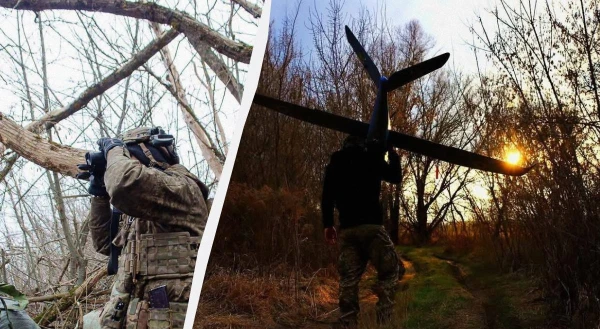
Russians have copied Ukraine's experience with FPV drones, and after the invasion of the Armed Forces of Ukraine into the Kursk region, changed their tactics regarding drone use.
Russian military forces have learned to better utilize the most lethal weapon of war - small and inexpensive drones - which had previously been one of Ukraine's main advantages.
Ukrainian fighters on the front lines and analysts told The Wall Street Journal that Russia's growing expertise in striking Ukrainian supply lines with drones is the most significant shift in the 2025 war - more substantial than the gradual conquest of territories by Russian troops.
Drone Dominance
This autumn, Russian forces have for the first time gained the upper hand in the battle for tactical drones. In key areas of the front, they outnumber Ukrainian drones while employing advanced tactics that challenge Ukraine's ability to supply its defenders on the front lines, WSJ writes:
"This trend does not bode well for Ukraine's ability to hold positions in 2026 if Ukrainian forces do not find a response to Russia's increased capabilities."
Crossing the Rubicon
Russia has steadily increased the use of small drones, employing them for reconnaissance, artillery fire control, or attacks on Ukrainian forward forces. It has also copied Ukraine's experience with FPV drones.
In 2024, after Ukrainian troops breached the Kursk region, Moscow changed its tactics regarding drone use:
"A new unit called 'Rubicon' attracted many of the best Russian drone pilots and attacked Ukrainian logistics in the Kursk region. They used fiber-optic drones connected to the pilot by a long cable so that the signal could not be jammed."
As a result, due to difficulties in transporting supplies, Ukrainian positions in Kursk were devastated, leading to a retreat. After that, 'Rubicon' expanded its operations, transferring the tools and tactics that worked in Kursk to the eastern front in Ukraine while simultaneously training other Russian drone units in its methods. Ukrainian officers noted that 'Rubicon' focuses on medium-range targets, typically at least 19 kilometers from the front line, bypassing Ukrainian infantry.
"They have two main tasks: to disrupt our logistics and to attack our drone pilots," said Yuri Fedorenko, commander of the 429th Achilles drone regiment.
Ukrainian logistics and drone units are now suffering greater losses than infantry on the front lines, stated Konrad Muzyka, director of the Polish military analytics company Rochan Consulting. The losses force Ukrainian drone pilots to launch their FPVs from farther positions, limiting the range of their attacks. Meanwhile, Russian drones with greater flight ranges are penetrating deeper into the rear.
"Russian combat training has overshadowed Ukrainian training for medium-range strikes," said George Barros, an analyst at the Institute for the Study of War in Washington. "They are targeting objects 40–70 kilometers from the front line. Previously, manned aircraft were required for such targets."
"The strike zone has shifted further behind Ukraine's front line than vice versa because Russia has improved its performance," said Rob Lee, a senior fellow at the Foreign Policy Research Institute.
The Battle for Pokrovsk
The battle for the city of Pokrovsk in the Donetsk region shows how significant an advantage Russia has gained in the use of tactical drones. The Armed Forces of Ukraine claim that Russian drones in this area now outnumber Ukrainian ones by a ratio of 10:1.
However, what worries many Ukrainian soldiers the most is how Russian long-range drones can strike their supply lines in Pokrovsk from distances of up to 64 kilometers, notes WSJ.
The roads are so dangerous for vehicles that Ukrainian soldiers walk the last 16 kilometers, said an officer from the 68th Jaeger Brigade defending Pokrovsk.
Drones also sometimes attack Ukrainians from the rear.
"When you see a drone flying towards the front, you think it’s one of ours. So it’s really difficult," Fedorenko said.
Countermeasures
Some Ukrainian officers say that their drone forces should pay more attention to strikes against Russian drone groups and logistics, copying the 'Rubicon' approach, rather than primarily focusing on destroying Russian infantry.
"Our main problem is resources. Their advantage is not in technology, but in scale," said the head of drone systems for Ukraine's 2nd Corps, known by the callsign 'Volt'.
Another issue is that Russia is receiving huge supplies of fiber-optic cable from China, while Ukraine is getting little from the West.
"Unfortunately, it must be stated that China is a stronger ally in this regard than the U.S. and Europe combined," Fedorenko says.
The Drone War in Ukraine
As Forbes writes, the war in Ukraine is finally turning into a "drone war against drones." Weather conditions have also become a factor: fog and rain open windows for enemy breakthroughs, as happened in Pokrovsk and in the Zaporizhia and Dnipropetrovsk directions.
Now, this new format of battles lacks an established doctrine - Ukraine and Russia are essentially developing it on the fly. The front is dissolving, communications are breaking down, and the lack of personnel on the front makes defense challenging.












Leave a comment