Every seventh infant on the planet is born with this curious phenomenon. It is important for parents to know how to help their left-handed child adapt in a right-handed world.
If you notice that a three-year-old child holds a spoon with their left hand, it does not necessarily mean they will become left-handed. At this age, toddlers actively use both hands. There is an opinion that the child's brain is plastic, and children are often taught to be right-handed by their parents.
After 4–5 years, by observing the child, one can make initial conclusions. Perhaps the preschooler indeed finds it easier to write with their left hand and kicks a ball more comfortably with their left foot. To be sure of your assumptions, you can conduct special tests available online or consult a psychologist.
If your little one turns out to be left-handed, that’s wonderful — they are unique, just like any other person, and they have many strengths. By the way, think about whether there were left-handed people in your family.
The most common reason for left-handedness is considered to be heredity. However, sometimes it is difficult to determine this, as until the mid-1980s, children were forced to retrain and do everything with their right hand. In earlier times, left-handedness was viewed with suspicion, and left-handed individuals could even be persecuted.
Fortunately, science has studied the issue of interhemispheric asymmetry and has proven that left-handedness is, in most cases, an individual variant of the norm for a healthy child. Left-handedness can have physiological causes related to damage to brain areas or intrauterine development disorders, but that is another topic.
Who is a Left-Handed Person?
The exact number of left-handed people in the world is unknown. Left-handedness can be natural (genetic), hidden (predisposition), and pseudoleft-handedness (forced left-handedness). According to some data, up to 25% of people are left-handed, which can be explained from an evolutionary perspective.
People with a dominant right hemisphere have certain neuropsychological characteristics. Recall that the left hemisphere controls the right side of the body, while the right hemisphere controls the left side. If a person is more active on the left side — hand, leg, eye, ear — then they are genetically left-handed.
A mixed type is more common, where it is easier to use the left hand in daily life, but the right leg or right ear is stronger. The ability to write with the left hand is not always an indicator of natural left-handedness.
Left-Handed Child: Their Characteristics
It was previously believed that left-handed children have psychological features due to the dominance of the right hemisphere of the brain, which is responsible for processing non-verbal information, visual perception, and intuition.
The left hemisphere is responsible for logic, analysis, language function, and mathematical thinking. Modern research shows that differences between left-handed and right-handed individuals exist, but they are exaggerated and mainly pertain to the emotional sphere.
What Distinguishes a Left-Handed Child?
* Right hemisphere children are more sensitive and intuitive. They are emotionally ahead of their peers and adapt more easily to new conditions.
* They perceive information visually and associatively, which makes their thinking unconventional and creative. Such children develop abilities in creativity, art, and science.
* Left-handed individuals find unconventional solutions in problematic situations, which can help them in the future both in life and in their profession. Among famous left-handed people were Leonardo da Vinci, Napoleon Bonaparte, Albert Einstein, and others.
* A left-handed child may have a larger vocabulary and broader outlook, although their speech functions may not develop as sequentially as those of right-handed children.
* A left-handed person can control their activities and change their direction, but they need support from parents and teachers to avoid overexertion.
What are Their Weaknesses?
Hypersensitivity makes a left-handed person vulnerable. They may be touchy and anxious, so it is not advisable to compare them with other children. A left-handed child may dwell on failures, leading to tantrums or aggression.
Teaching left-handed children has its nuances, as the education system is oriented towards right-handed individuals. A left-handed child may find it difficult to adhere to strict rules and may experience challenges with writing and spatial orientation.
What Parents Need to Know
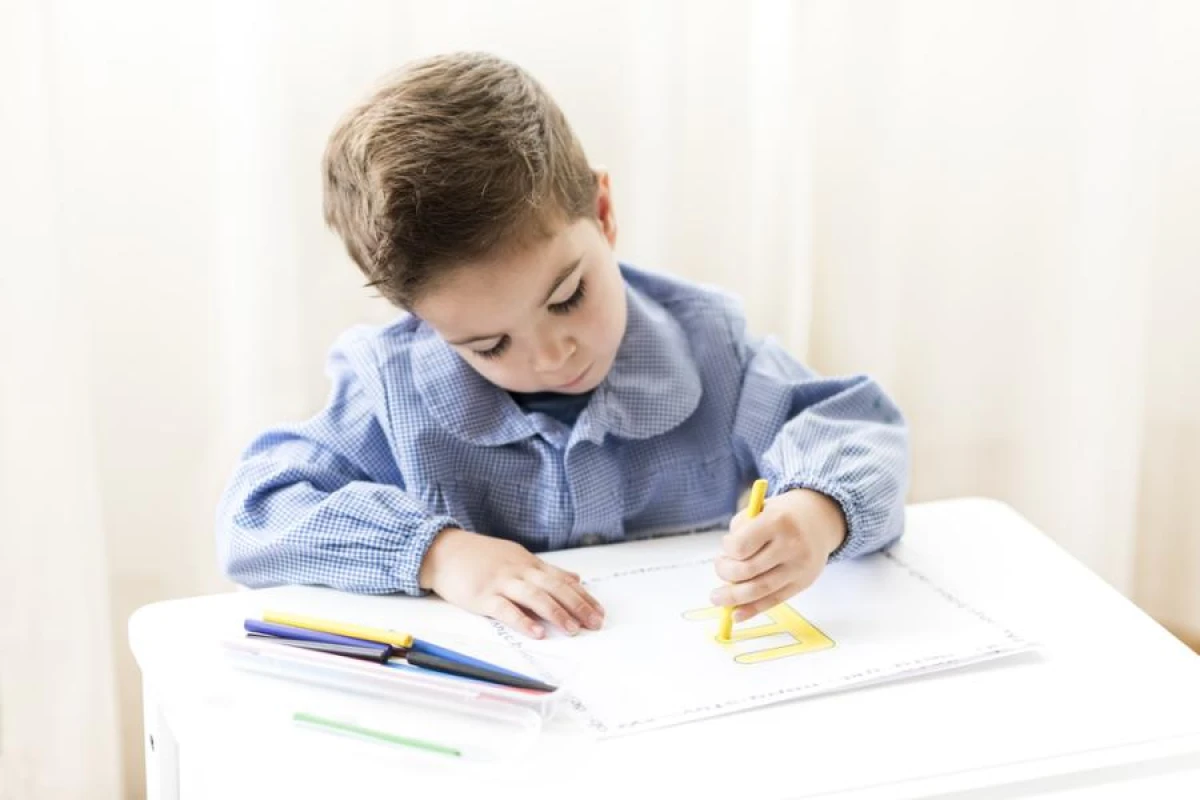
Do not try to retrain your child to write with their right hand. A left-handed child should have the opportunity to be themselves, as retraining can lead to psychological problems.
Do not expect outstanding results from them, as intelligence depends on the interaction of both hemispheres and other factors such as genetics and upbringing.
Inform caregivers and teachers that your child is left-handed so that they treat them with understanding and do not criticize their habits.
When choosing educational clubs and schools, opt for simple training programs. Help your child with their homework so they feel supported and confident.
Exercises for fine motor skills, such as modeling and drawing, will help a left-handed child adapt to right-handed tasks.
A left-handed person sees the whole picture, so consider this feature when teaching.
When organizing a workspace, place the lamp on the right. A left-handed person holds the pen 3-4 cm away from the paper, not 2 cm like a right-handed person. Do not require them to write without looking.
It is important to see individuality in the child and build communication considering their characteristics, regardless of whether they are right-handed or left-handed.