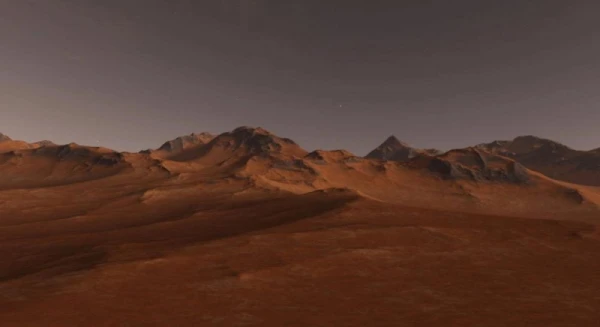
Nickel is typically just a trace element on planetary surfaces, as most of it goes into the cores during formation. However, the Perseverance rover has discovered rocks on the Red Planet with surprisingly high levels of this metal, raising many questions.
NASA's Perseverance rover has made an astonishing discovery in ancient Martian rocks. It found abnormally high levels of nickel, indicating a unique chemical environment that existed billions of years ago. This sensational discovery is reported by Daily Galaxy.
This finding, made in the picturesque Neretva Vallis, strikingly resembles mineral formations that on Earth are often associated with microbiological activity. Although this is not direct evidence of life on Mars, it adds an intriguing element to the long-standing scientific investigations of the Red Planet.
Since February 2021, Perseverance has been meticulously exploring the Jezero crater—a massive 45-kilometer diameter basin that scientists believe was once a water-rich lake. Dr. Henry Manelsky and his team from Purdue University note that the crater holds clear signs of ancient water activity, including river channels and sediment deposits.
Over time, the rover reached Neretva Vallis—an ancient river delta. Here, remarkable deposits have been preserved, estimated to be about 3 billion years old.
To study these rocks, Perseverance utilized a sophisticated array of tools: lasers, infrared, and X-ray instruments. The results, published in the prestigious journal Nature Communications, showed that nickel was found in 32 out of 126 analyzed samples, with concentrations reaching an impressive 1.1% by weight.
Dr. Manelsky explained that nickel typically occurs only in trace amounts on the surfaces of Earth and Mars. This is because the overwhelming majority of this element migrates to the cores of planets during their formation.
"The significant amount we found on the surface imposes unique constraints on how these rocks formed and subsequently underwent changes," the researcher emphasized.
This discovery set a record: the recorded level of nickel is the highest ever measured in Martian bedrock. This element was found alongside iron sulfide minerals and sulfates, such as jarosite and akaganéite, which form as a result of the slow weathering of these rocks.
"Nickel-rich iron sulfide is observed on Earth in ancient sedimentary rocks. Iron sulfide weathers easily in oxygen-rich environments, so its presence in ancient Earth rocks is one of the pieces of evidence that the early atmosphere of Earth was once very low in oxygen," Manelsky explained.
Astonishing Similarity to Earth Minerals
Researchers were particularly struck by the remarkable similarity of these Martian minerals to pyrite—a very common iron sulfide on Earth. On our planet, such formations are often associated with microbial processes. This is especially evident in low-oxygen conditions where sulfates and iron are present.
In this same region, iron sulfides were found alongside organic carbon compounds. This combination may indicate biological activity, although it is also possible that it results from ordinary chemical reactions.
"The presence of nickel-rich rocks suggests that if living organisms existed on early Mars, nickel could have been available in a form they could use," the researcher said.
The Mystery of Nickel's Origin
The source of this mysterious nickel remains unclear. Scientists have proposed several hypotheses: it may have formed from the breakdown of volcanic rocks or been brought in by nickel-rich meteorites.
"Further studies are needed to determine the source of nickel in Neretva Vallis and to explore potential connections between it and organic matter in this area," the study authors noted.
Other Scientific Discoveries
Recently, scientists have also conducted extensive studies on gravity, confirming its action in precise accordance with the predictions of Newton and Einstein. The results show that the force of gravity weakens with distance, following the law of inverse square dependence first formulated by Isaac Newton.
Additionally, there have been reports of a mysterious incident under Antarctica, where the underwater vehicle Ran discovered unknown objects. Unfortunately, contact with it was lost, and it disappeared. This vehicle had been scanning a vast area of ice covering about 129.5 square kilometers for several weeks.