
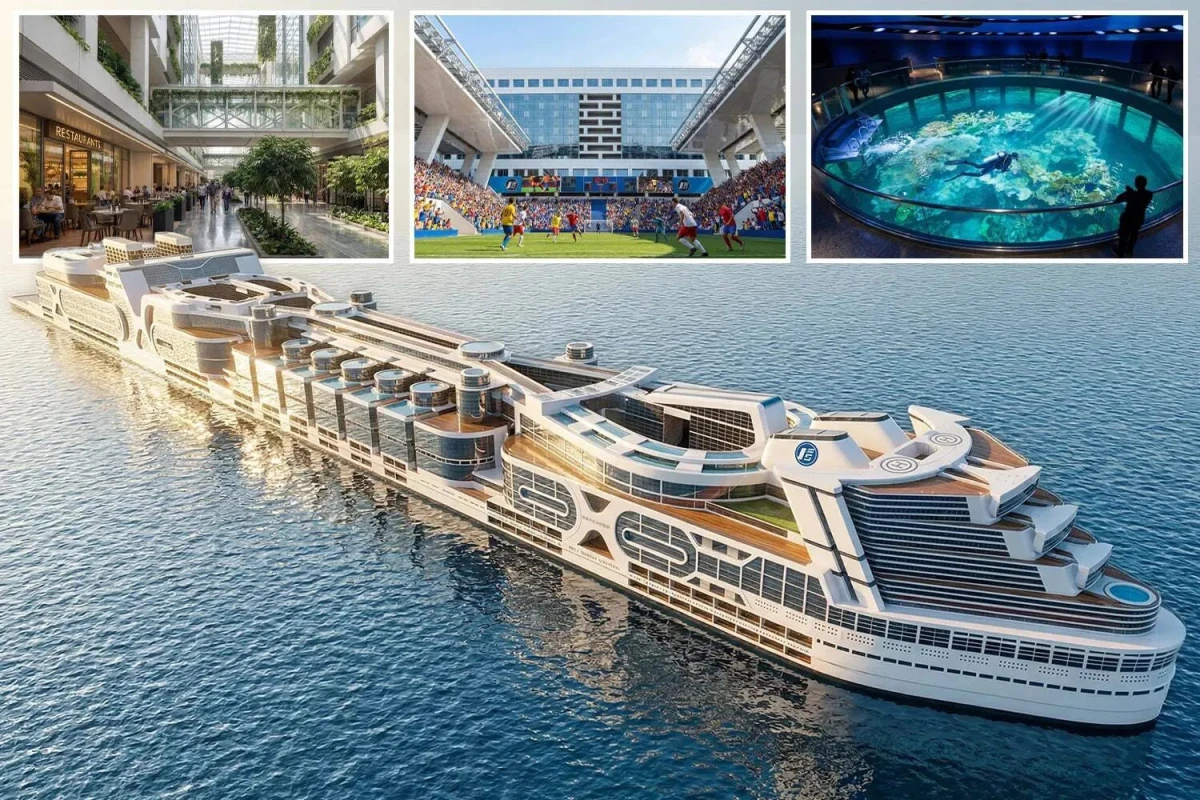
A nuclear engine will be required to move the 1.8-kilometer structure.
Freedom Ship is one of the most unusual engineering projects of the late 20th and early 21st centuries, which still attracts the interest of architects, engineers, and futurists. Its essence is simple yet almost fantastic: to create a giant floating city capable of permanently residing in the ocean and accommodating tens of thousands of people living there a full life.
The idea for the project emerged in the 1990s thanks to American engineer Norman Nixon. He proposed the concept of not just a large ship, but a true autonomous city on water. In his vision, it was to be a place where people could live, work, study, relax, and travel without leaving the vast marine platform.
After Nixon's death in 2012, the project was effectively frozen, but later it was attempted to be revived under the leadership of Roger Gooch and Freedom Cruise Line International. Since then, a small team of specialists has been working around the idea, continuing to develop the concept and update its visualizations.
According to the developers' plans, Freedom Ship is intended to become the largest marine structure in human history. Its dimensions are impressive: approximately 1.8 kilometers long, about 250 meters wide, and over 30 decks high. This makes it several times larger than the largest modern cruise liners. In fact, it is not a ship in the conventional sense, but a floating city comparable in scale to a small metropolis.
The project is designed for about 80,000 people. Of these, about 50,000 are to be permanent residents, around 10,000 temporary guests and tourists, and approximately 20,000 staff members ensuring the operation of the entire system. Thus, the population of this city is comparable to that of a large district center, where life is expected to be organized completely autonomously.
The internal structure of Freedom Ship is described as a full-fledged urban environment. It is planned to accommodate residential quarters, schools, hospitals, offices, shopping centers, hotels, restaurants, and recreational areas. Additionally, cultural and sports facilities are to operate inside, including a stadium for 15,000 spectators, a water park, museums, concert venues, and conference centers.
Park areas and walking paths are provided, as well as a transportation system allowing movement across the vast area of the vessel. Some descriptions of the project even mention a walking path approximately 24 kilometers long, emphasizing the scale of the envisioned space.
Particular attention in the concept is given to the lifestyle on board. Freedom Ship is envisioned as a constantly moving city that will travel around the world. The vessel is supposed to move at a speed of about seven knots, or approximately 13 kilometers per hour, and make round-the-world routes while remaining in international waters. It is planned that a complete circumnavigation of the globe could take several years, and the city will periodically approach various regions, allowing passengers to visit or leave the ship.
One of the most discussed details of the project is the proposed energy system. Some descriptions mention the use of a nuclear reactor, which is expected to provide the giant city with the necessary energy. Additional sources, such as solar panels and other alternative technologies, are also being considered. However, detailed technical documentation on this issue has not been published in full.
The financial assessment of the project is also impressive. The cost of constructing Freedom Ship is estimated at around $16 billion. In comparison, this is significantly more than the budgets of the largest cruise liners in history. Meanwhile, the project remains at the conceptual stage, as the necessary funding has not yet been secured.
The safety of such a structure raises separate questions. Engineers and critics note that building a ship nearly two kilometers long poses enormous technical challenges. Marine loads, waves, and constant deformations of the hull become critical factors for structures of this scale. Additionally, issues of evacuating tens of thousands of people in emergencies, ensuring stable life support, waste disposal, and protecting complex energy systems remain unresolved. These problems are currently considered the main obstacles to the project's realization.
Despite this, supporters of Freedom Ship are confident that modern technologies have already brought humanity closer to the possibility of creating such floating cities. They view the project as a step towards a new form of urbanization, where national borders lose significance, and life becomes mobile and global.












Leave a comment