
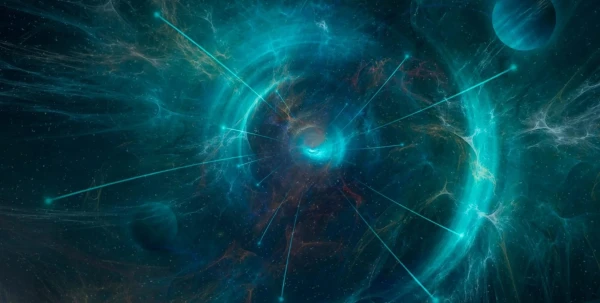
Time travel does not contradict Einstein's general theory of relativity in some sense. But it is not that simple, writes Focus.
Cosmic strings are a kind of "scars" left over after the Universe abruptly changed from a high-energy environment to a low-energy one in its early stages. Physicists believe that cosmic strings can warp space-time, creating a closed time-like curve. Theoretically, this could allow for time travel. However, scientists do not yet know how to travel through time using cosmic strings. Future observations may reveal more about how this could happen, writes Popular Mechanics.
"Scars" in the Fabric of Space-Time
It is believed that before the Big Bang, our Universe was a very hot, very dense, and extremely high-energy place. Everything changed when the Big Bang occurred 13.8 billion years ago. The rapid initial expansion of the Universe led to the emergence of the four fundamental forces of nature: gravity, electromagnetic interaction, weak interaction (responsible for radioactive decay), and strong interaction (which holds atomic nuclei together). Elementary particles were also created at this time. Ultimately, this abrupt change in the Universe left "scars" in the fabric of space-time. Physicists refer to them as cosmic strings.
Cosmic strings are artifacts of what the Universe looked like just before it rapidly transitioned from a high-energy environment to a low-energy one. These strings are about the same thickness as a proton, extremely dense, and can stretch for light-years.
Physicists believe that cosmic strings passively drift through the Universe, but their active study could be the key to a kind of time travel.
A Time Machine in Space
Ken Olum, a physicist and astronomer at Tufts University, says that two infinite parallel cosmic strings passing by each other would create a time machine by warping space-time. As a result, if you were to move along a trajectory along these strings, you would return to your starting point before you left it.
Although the mathematical calculations explaining this time travel using cosmic strings are correct, Olum says that one should not get too excited. The problem is that scientists have never observed cosmic strings.
The Theory of Time Travel Using Cosmic Strings In 1991, physicist John Richard Gott proposed the most popular idea of time travel using cosmic strings. He suggested that two infinite parallel cosmic strings passing by each other could distort space-time, creating a time loop known as a closed time-like curve. This time loop returns the time traveler to their reference point before they left.
The existence of such a time loop is suggested by Einstein's general theory of relativity. According to this theory, massive objects can warp space-time, allowing for the possibility of shortening the path through time by compressing space. Closed time-like curves also explain how wormholes theoretically work. These are hypothetical tunnels through which one can quickly travel through time and space.
Time Travel Is Unlikely, but Not Impossible
The mathematical foundation of the theoretical superhighway of cosmic strings is correct, but that does not necessarily mean we are close to time travel. First, moving at speeds close to the speed of light, which is necessary for such travel, is very difficult to achieve, if at all possible. Second, according to Einstein's general theory of relativity, the faster an object moves, the more energy it requires for further acceleration. But there is currently no way to produce the enormous amount of energy needed to accelerate a spacecraft to nearly the speed of light.
Henry Tai, a physicist at Cornell University, says that compared to other theoretical methods of time travel, such as wormholes, he is more convinced of the possibilities of cosmic strings. The scientist states that time travel is unlikely, but it cannot be said to be impossible. However, before creating a time machine, scientists need to discover cosmic strings.
Fortunately, this discovery may be closer than ever, thanks to the NANOGrav project. Astronomers from this project are searching for low-frequency gravitational waves, and in 2020 they already detected a signal that differs from all other gravitational wave signals. Scientists believe this could be a signal coming from cosmic superstrings.
Unlike cosmic strings left over from the early Universe, cosmic superstrings originate from string theory. This theory suggests that the Universe consists of ten dimensions, of which only four make up space and time as we know them. The other dimensions represent a kind of invisible framework. In this model of the Universe, very small objects called strings replace elementary particles.
According to Olum, the strings from string theory could have been significantly stretched by some mechanism in the early stages of the Universe's existence, transforming into cosmic superstrings that are easier to detect.
To confirm whether these signals indeed originated from cosmic strings, scientists will need more data, which is expected to arrive in the coming years.
Tai states that if new data confirms the existence of cosmic strings, especially cosmic superstrings, it would change everything we know about physics. If cosmic strings one day change physics, then it may be possible for scientists to understand how to travel through time using cosmic strings.












Leave a comment