

A car is not a luxury but a means of transportation, your author realized when he found himself at 7 AM in the practically deserted area of Čiekurkalns at the infamous -10, which "feels like -15." All because, on the way to work, the little car resolutely refused to shift gears.
I managed to crawl to my local service station in first gear with a jammed gearbox, but, of course, the gates were firmly closed. I left the car and headed to the bus stop for the 9th bus, freezing alongside a dozen other residents of this glorious, historic neighborhood.
The cause of the breakdown was, of course, the relentless passage of time. When a vehicle's age surpasses ten years, the risk of malfunction inevitably increases. However, a trigger is still needed, a direct cause. I think this time it was the repeated skids and the necessity to rev the engine hard when exiting snowy and icy traps. I wonder how many LR car owners face similar troubles in a year – the statistics remain silent...
Strictly Paid Passage – But Maneuvering is Possible
However, if it comes to that, the state should have made an effort regarding road expenses, as it collects significant fees from those transporting goods on the country's highways. For example, the highest rate for vehicles weighing between 3001 and 3500 kg – the widest range of commercial vehicles – is currently 510 euros per year. It is proposed to increase this to 630 euros. However, there will be a zero rate for zero-emission vehicles, which should encourage the transition to electric trucks. But where are they sold in sufficient numbers, and how much will they cost?
So, under current conditions, the main roads of the republic (see map) are exclusively paid for commercial transport.
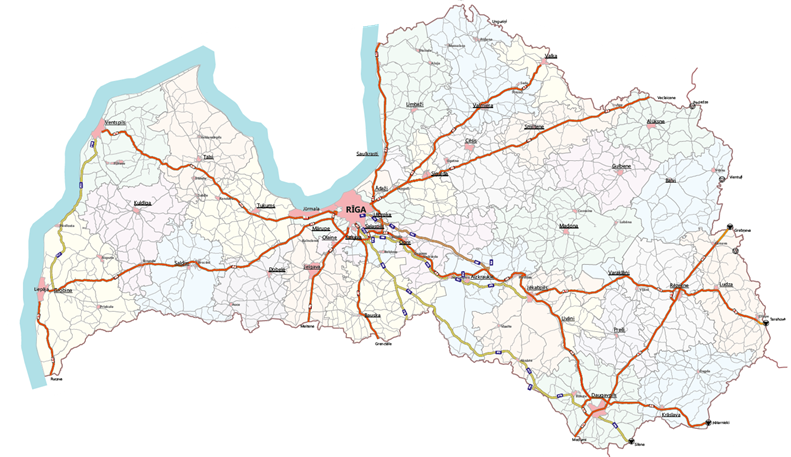
However, the Latvian toll collectors for road usage (ALN) faced a severe setback – if in 2024 it was planned to collect 32,370,000 euros, the shortfall was 3,372,409 euros; then in 2025, the plan was raised to 58,784,723 euros, and the shortfall amounted to 19,794,189 euros!
In fact, if you decided to play at planned economics, turkeys, let me remind you – this is called storming. When inflated indicators are invented, for which there is no basis. Only an extreme detachment from local realities, where economic activity is at best stagnating, can explain why it was suddenly necessary to nearly double the road tolls.
However, it is quite possible that the organizers of national transport sincerely believed – that the construction of the Eastern border and other efforts in the military-industrial complex, as well as the presence of foreign armed forces, would give domestic roads such unimaginable traffic that you would just have to hold out your wallet! But – alas, there is a hole in the treasury, and the roads are unplowed and full of potholes.
What Are the Reasons for the Shortfalls
The Ministry of Transport, led by Atis Švinka (“Progressives”), sent its thoughts to the Saeima on why this is happening all of a sudden:
-
Decrease in transit flow at the external borders of Latvia;
-
Some carriers evade ALN by using roads outside the toll zone;
-
Decrease in the purchase of 1-day vignettes, significant impact;
-
More 7- and 30-day vignettes are purchased, relatively small impact.
By the way, regarding alternative routes – there are quite a few. To avoid paying money on Via Baltica, for example, when traveling from Riga to Estonia, one can make a smooth arc – first go to Madona, then to Gulbene, Alūksne, and then there will be Veclīčene and the border. The routes to the Lithuanian border will be much more winding, but in principle, it is also a solvable issue.
In total, there are over 66,000 vehicles subject to taxation, according to the Road Traffic Safety Department (CSDD). It is estimated that about one in five of these vehicles does not pay ANL. Among non-payers, 27% are individual owners, the rest are legal entities.
Which Sectors Will Pay for This
In 2026, as already noted, the fees are expected to be raised again – and primarily this will affect trade, extracting 5.3 million euros from it, which will go towards the infamous vignettes. The delivery of goods to stores is mainly carried out by medium commercial vehicles, and the costs for this conditional van will somehow be spread across the general price tags in stores.
Next comes construction, the administrative sector, energy, and gas supply... I’ve almost finished the list – who pays for the trucks? And I found no... industry!
However, from the information of the Ministry of Transport, it immediately becomes clear where economic activity exists in Latvia – it can be established by the addresses of the toll payers. There is a significant imbalance with Riga and the surrounding area prevailing. However, there are several administrative territories where there are practically no significant users of freight transport – these are the Valka, Madona, Balvi, Preiļi, and Krāslava regions.
The Ministry of Transport places the primary burden of paying fees on the largest cohort of entrepreneurs. It is expected that in 2026, micro and small enterprises will contribute 6.8 million euros more for road usage. For comparison – large businesses will pay only 1 million more. A unique example of "concern" for the entrepreneurial environment!
In total, for the upcoming year, they hope to collect 15.8 million euros more in the treasury than was actually achieved in 2025. "The overall impact on the national economy is low; however, the burden on individual enterprises may be significant."
Well, returning to our sheep – I personally paid 565 euros for the clutch replacement, including VAT. So, in my own way, I helped improve the economy of Latvia!










Leave a comment