
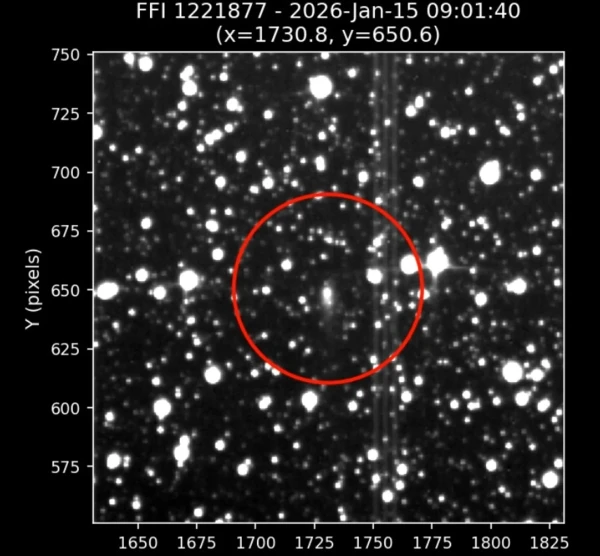
NASA's TESS space telescope, designed to search for new planets, captured the movement of a guest from another star system. New data, scientists hope, will provide more information about this enigmatic object, writes Focus.
Interstellar object 3I/ATLAS, which NASA and most astronomers consider a comet that arrived from another part of the Milky Way, was discovered in early July 2025. In late October, comet 3I/ATLAS came to its closest distance to the Sun, in December – to Earth, and is now flying towards Jupiter to permanently leave the Solar System. NASA's TESS space telescope, designed to search for new planets, captured the movement of comet 3I/ATLAS as it departs our star system. According to scientists, the data obtained may help uncover some mysteries of this enigmatic interstellar object, writes Space.
3I/ATLAS has many strange features, including an unusual chemical composition, unlike that of known comets, as well as an unusual trajectory that allows the interstellar object to approach the planets of the Solar System relatively closely. Therefore, some scientists have suggested that it might not actually be a comet, but rather a spacecraft of an extraterrestrial civilization. However, this theory is not supported by most astronomers, including those from NASA, who assert that it is, albeit strange, a comet.
The TESS space telescope searches for planets located outside the Solar System using the transit method. A distant star loses its brightness for a time when a planet passes in front of it. This way, TESS identifies new worlds. However, TESS's wide field of view also makes it useful for detecting and tracking objects in the Solar System, including comets and asteroids.
During a special series of observations from January 15 to 22, the TESS telescope observed interstellar object 3I/ATLAS as it was leaving the Solar System. TESS recorded the comet as a bright, fast-moving point leaving a faint tail against the backdrop of a star-filled sky. Unfortunately, TESS's observations were interrupted when it entered safe mode due to a problem with its solar panels.
Scientists want to use the data obtained to study the comet's activity, which will help understand how intensely it is shedding dust and gas into space and how quickly its core is rotating. Perhaps this data will help uncover some secrets of 3I/ATLAS.
New data showed that the brightness of comet 3I/ATLAS is at a magnitude of 11.5. The lower the number, the brighter the object, making it easier to see with the naked eye. People can see objects with a magnitude of up to 6 in the night sky without telescopes or binoculars.
Although comet 3I/ATLAS was discovered last July, NASA scientists found that the TESS telescope observed this interstellar object as early as May, as archival images showed. By analyzing all the data and combining numerous observations, astronomers were able to track the movement of the interstellar visitor.













Leave a comment