The resistant hydrocarbons in the samples from Florida and Brazil turned out to be identical.
Ocean pollution by oil and plastic is a global environmental issue that scientists have long been discussing. It turns out that these two types of pollutants can combine into hybrid formations that can travel thousands of kilometers across the seas.
Plastic waste and petroleum products remain among the most serious threats to the World Ocean. Until now, they have mostly been studied separately. It was believed, for example, that spilled oil rarely travels more than a few hundred kilometers from the source due to rapid natural degradation caused by sunlight, waves, and microorganisms.
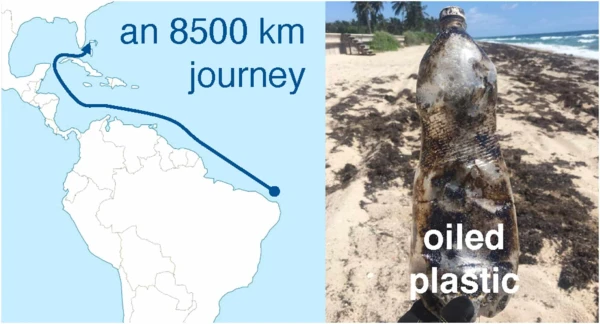
A study published in the journal Environmental Science & Technology examined plastic and oil in the ocean as interconnected pollutants for the first time. The research was conducted based on the oil spill off the coast of Brazil in 2019, the source of which was never identified. In the summer of 2020, volunteers began finding unusual plastic and glass bottles covered with a layer of black, tar-like substance on the beaches of Florida (USA).
Using mathematical modeling, the authors calculated the trajectories of these objects. The calculations showed that currents could have brought the particles from the Brazilian coast in about 240 days. At the same time, the scientists conducted a comparative chemical analysis of the samples. By applying two-dimensional gas chromatography and ultra-high-resolution mass spectrometry, they separated and studied the composition of the pollutant.
The analysis revealed that specific compounds were a processed petroleum product rather than crude oil. The absence of light fractions in the composition proves that the pollutant had been in the open sea for months and lost these components due to evaporation and dissolution. At the same time, the complex, resistant hydrocarbons in the samples from Florida and Brazil turned out to be identical. This confirmed that the petroleum product found in the USA indeed originated from South America.
Thus, scientists have for the first time demonstrated such a long transatlantic transfer of oil pollution. The resulting pollutant also turned out to be unique—a hybrid that can be called 'oil plastic.' The two main ocean pollutants, interacting, created a new, more stable, and mobile threat. Plastic protected the oil from rapid degradation, while oil, in turn, altered the properties of the plastic—such as its buoyancy or ability to adsorb other substances.
It is still not entirely clear how significantly such a hybrid pollutant affects marine ecosystems and the ocean as a whole during its long journeys. This is due to the fact that monitoring 'oil plastic' as a separate class of pollutants is virtually nonexistent.