
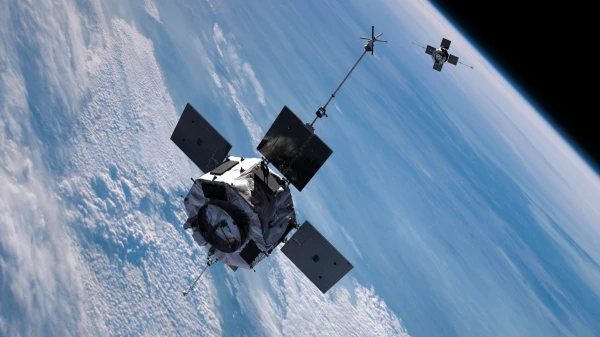
As NASA predicts, an uncontrolled re-entry of the approximately 600 kg NASA Van Allen Probe A satellite into the Earth's atmosphere is expected in the coming hours. This spacecraft was launched in August 2012. It is time to come home.
The primary mission of the satellite was to study the Van Allen radiation belts — zones of high radiation around the Earth that protect the planet from solar and cosmic radiation, but also pose a danger to satellites and astronauts at certain orbits.
The satellite was designed to operate for two years, but it lasted much longer — until October 2019, providing scientists with a vast amount of data on the dynamics of the radiation belts and space weather.
After the active phase of the mission ended, the Van Allen Probe A gradually lost altitude due to atmospheric drag.
Increased solar activity in recent years has caused the upper layers of the atmosphere to expand, which intensified the drag and accelerated the descent of the orbit.
According to the U.S. Space Force forecasts, re-entry into the atmosphere is expected on March 11 at approximately 01:45 Latvian time.
The exact time and location are being refined as the event approaches, but the trajectory has a low orbital inclination (about 10°), so debris is most likely to fall in the equatorial zone — predominantly over the ocean.
Most of the 600 kg satellite will burn up in the dense layers of the atmosphere. NASA and experts emphasize that some sturdy components (such as individual metal parts) may survive the heating and reach the surface.
Nevertheless, the risk of harm to people or property is assessed as very low — about 1 in 4200 (approximately 0.024%). This is due to the fact that about 70% of the Earth's surface is covered by oceans, and populated areas occupy a relatively small area. Most of the debris is expected to fall into the open ocean.















Leave a comment