
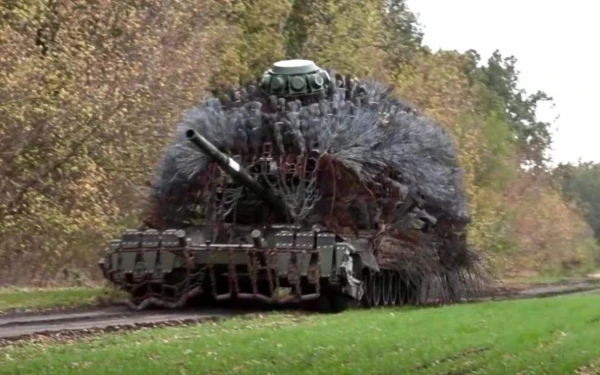
Russia is testing a new anti-drone armor for tanks and armored vehicles called "dandelion," combining flexible metal rods and a three-dimensional mesh.
New improvised solutions from the Russian army are causing mockery online, but experts acknowledge: in the drone war, even the most unusual designs can temporarily save equipment and lives, writes The Telegraph.
From "Turtle Tank" to "Dandelion"
Russia continues to experiment with unconventional ways to protect armored vehicles from FPV drones. After the "turtle tank" and the so-called "hairy tank," a new design has appeared on the battlefield, already dubbed the "dandelion aquarium."
This refers to a multilayered structure made of flexible metal rods, welded into a tree-like shape and covered with a high-strength mesh. It is intended to create a three-dimensional barrier around the tank and cause drones to explode at a distance from the hull.
How the "Dandelion Armor" Works
The new system was first spotted on a Russian T-90M tank in a warehouse. The Russian Ministry of Defense has already patented this design, although it is unclear when it will be mass-produced for combat conditions.
The principle is simple: if an FPV drone with explosives crashes into the metal rods, detonation occurs before it reaches the main armor.
"Every additional centimeter of distance increases the tank's chances of survival," the publication notes.
Military correspondent David Axe, in his Trench Art blog, called this combination "the best passive protection against drones available today," if combined with basic armor, dynamic protection, and metal cages.
Evolution of Strange Solutions
The "dandelion" is an improved version of the "hedgehog" type armor that Russian troops used earlier, and subsequently, similar solutions began to be used by Ukrainian units.
"At the front, it is worth experimenting with everything: spikes, chains, cages, or their combinations, if it can save lives," explained weapons expert David Kirichenko.
According to him, the war has turned into a continuous race of adaptations and countermeasures.
Ukraine is Also Experimenting
Earlier this week, Ukrainian military showed a new design of a heavy infantry fighting vehicle that combines "dandelion-like" armor, metal "bristles," and sheets hanging on chains.
"This is part of the endless development of experimental and strange inventions on both sides," noted Kirichenko.
Disadvantages and Vulnerabilities
However, such systems have serious downsides. Additional protection increases the weight of the vehicles, reduces maneuverability, and makes them more vulnerable to attacks from the front or below.
Ukrainian forces are increasingly using drones that strike under the hull of vehicles - the weakest point, or drop mines from the air.
According to Defence Express analyst Valery Ryabykh, the "dandelion" is ineffective against traditional weapons, particularly precision artillery.
"Against drones, it may work for a certain time - until the enemy finds a way to bypass or break through this protection," he noted.
Camouflage, Propellers, and Time War
In addition to armor, Russia is testing camouflage nets that imitate brick debris, as well as even giant rotating propellers to protect civilian vans from drones. Most experts consider the latter idea questionable and economically unjustified.
However, as Ryabykh concluded, "any, even strange innovation can buy time." And on the modern battlefield, where drones determine everything, time often means survival.














Leave a comment