
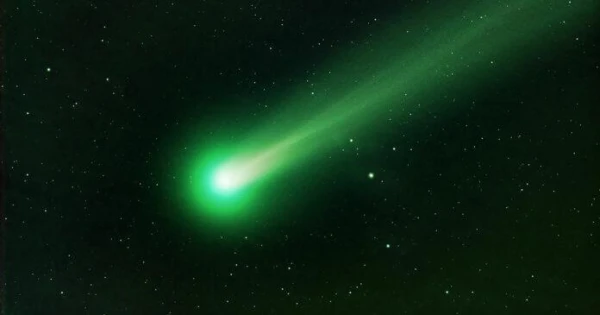
For the comet C/2026 A1 (MAPS) to become an impressive sight, it must first survive a close encounter with the Sun.
The comet C/2026 A1 (MAPS), discovered earlier this year, is rapidly increasing in brightness and may become visible in the sky not only after sunset but also during the day. However, the comet must first survive its passage through the upper layers of the Sun's atmosphere, writes Focus citing Space.
The comet C/2026 A1 (MAPS) was discovered in January 2026 at a distance of 308 million kilometers from the Sun. This is the farthest distance at which a comet has been discovered in the Solar System.
At the time of its discovery, the comet had an apparent magnitude of 18, but since then its brightness has increased by 600 times and continues to grow. The apparent magnitude determines how bright an astronomical object is. The lower the apparent magnitude, the higher the brightness. For example, the apparent magnitude of the Sun is minus 27. The human eye can see an object in the night sky with a maximum apparent magnitude of 6.
Scientists believe that from April 5 to 14, the comet C/2026 A1 (MAPS) could have an apparent magnitude of minus 5, meaning it could become one of the brightest comets of 2026. The brightness of comets increases as they approach the Sun. Comets are icy bodies whose cores begin to vaporize under the heat of our star, forming a comet's coma made of dust and gas. The larger the coma, the more light it reflects, and thus the greater the brightness of the comet.
But there is one problem with the comet C/2026 A1 (MAPS). It belongs to a group of comets known as Kreutz sungrazers. Many Kreutz comets disintegrate after approaching the Sun, although some manage to survive and continue their journey through the Solar System.
Some of the brightest comets in history belonged to the Kreutz sungrazers. For example, these comets included C/1965 S1 (Ikeya-Seki) in 1965 and C/2011 W3 (Lovejoy) in 2011. They could be seen not only at night but also during the day.
The comet C/2026 A1 (MAPS) will make its closest approach to the Sun on April 4. It will be at a distance of 159,300 km from the Sun's surface. This means that the comet will pass through the upper layer of the Sun's atmosphere, known as the corona, where temperatures exceed 1 million degrees Celsius. Therefore, there is a possibility that the comet could be completely destroyed.
Still, scientists believe that if the comet's speed reaches over 1.5 million km/h, it may avoid destruction. Thus, the comet could have an apparent magnitude of minus 5 and could be visible even to the naked eye at night for at least a week. On April 5, it may even be visible during the day, but observing it will require telescopes with special filters to prevent sunlight from damaging the eyes.
Even if the comet C/2026 A1 (MAPS) disappears, photographs taken by spacecraft when it is closest to the Sun will still be obtained.














Leave a comment