
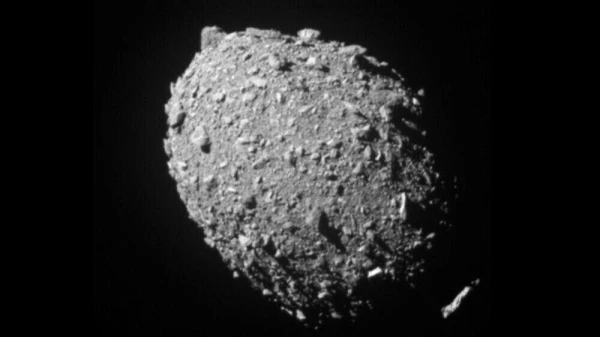
In the scale of science and long-term perspective, a very significant result has been achieved.
The orbit of the asteroid Didymos, into which a NASA spacecraft intentionally crashed in 2022, has been successfully adjusted as a result of this experiment. The 770-day orbit of the pair of celestial bodies around the Sun changed by fractions of a second, confirmed the team of American scientists in a new study, the results of which were published by the journal Science Advances and the space agency's website.
The mission, called DART (which stands for Double Asteroid Redirection Test), was launched in September 2022 to determine whether human-made methods can change the trajectory of asteroids that pose a threat to Earth.
Neither Didymos nor its smaller moonlet Dimorphos posed a real threat but were chosen as "test subjects". A kinetic impact was made on Dimorphos using a spacecraft, with the expectation that the wave would also affect its "big brother".
"Didymos and Dimorphos are gravitationally bound and rotate around a common center of mass in a configuration known as a binary system, so changes occurring with one asteroid affect the other," NASA's website notes.
As the study published on March 6, 2026, showed, as a result of the experiment, the asteroids continued to orbit the Sun, but a noticeable shift occurred in their overall orbit. This was stated by Raheel Makadia, who led the research at the University of Illinois, in an interview with The New York Times (NYT).
"Dr. Makadia enlisted the support of dozens of amateur astronomers from around the world, including from Australia, Japan, and the United States. They precisely measured the position of the pair of asteroids as they passed against the backdrop of distant stars at different points in their orbit," the publication notes.
These measurements showed that the deviation of the asteroids from their orbit was only 150 milliseconds per orbit around the Sun. Despite the small change from a layman's perspective, in the scale of science and long-term perspective, this is a very significant result, explained Thomas Statler, a senior scientist studying small bodies of the Solar System at NASA headquarters.
"This is a minor change in orbit, but over time even a small deviation can lead to a significant change in trajectory. The remarkably precise measurements conducted by the team further confirm that kinetic impact is an effective method of protecting Earth from asteroids," the scientist is confident.
Will the "Moon Killer" fly by?
On the eve of the publication of the study about Didymos and Dimorphos, NASA also shared information about another asteroid that was considered a potential threat to the Moon in 2032.
As specialists noted on the agency's website, according to the latest observations using the James Webb Space Telescope, the asteroid 2024 YR4 will approach the Moon on December 22, 2032, at a distance of 21,200 km but will avoid a collision with Earth's satellite.
Before the data was clarified, scientists estimated the probability of a collision of 2024 YR4 with the Moon at 4.3%.
2024 YR4 belongs to the class of medium-sized asteroids, sometimes referred to as "city killers." It was discovered using the ATLAS observatory in Chile in 2024 — the same one that detected the notorious comet 3I/ATLAS last year.













Leave a comment