
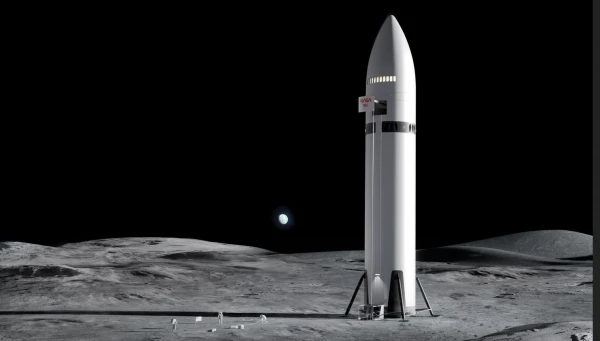
The new report on lunar landers provides some interesting insights that were previously unknown to the public.
NASA's Inspector General has published a new report examining the agency's management of contracts for the development of lunar landers signed with SpaceX and Blue Origin. These landers are necessary for NASA's Artemis program, which aims to return astronauts to the Moon's surface for the first time since 1972. The program also envisions the establishment of a long-term settlement on the Moon. However, NASA, along with SpaceX and Blue Origin, has largely remained silent on the development of the landers. The new report provides some interesting insights that were previously unknown to the public, writes Focus citing Arstechnica.
Overall, the report notes that the approach to contracting with SpaceX and Blue Origin has been beneficial for NASA, but this does not mean there are no challenges.
One of these challenges relates to whether astronauts aboard SpaceX's Starship lander should have the capability to take manual control of the vehicle during descent to the Moon's surface.
The report states that there are disagreements between NASA and SpaceX regarding whether the approach proposed by Elon Musk's company for landing on the Moon meets the agency's requirements for manual control.
The report points out that during each lunar landing under the Apollo program, astronauts had a backup method for manual control.
As NASA and SpaceX approach a key decision-making milestone, this issue remains unresolved. The new report suggests that this could lead to automation being the only method for landing astronauts on the Moon's surface.
Ten years ago, NASA and SpaceX had similar disputes during the design process of the Crew Dragon spacecraft. Initially, SpaceX wanted to use only touchscreen controls with a limited set of commands for astronauts. NASA objected and wanted astronauts to control the vehicles essentially using joysticks. A compromise was reached at that time, allowing astronauts to manually control the spacecraft using controls on the touchscreens.
However, the new report states that the Crew Dragon's flight control system was developed based on numerous successful missions of the cargo version of the vehicle in space.
The lunar lander Starship does not have such successful missions to rely on for developing control systems. But the manual control system is critically important for crew survival, the report states.
According to the Inspector General, the design of the manual control system for Blue Origin's lander has not yet been developed.
The report also contains other information, including details about the uncrewed demonstration flights that SpaceX and Blue Origin must conduct before beginning crewed missions to the Moon. The Inspector General notes that these flights will not require life support systems and airlocks, as will be needed for crewed missions.
There will also be limited opportunities to test the abrasive effects of lunar dust on life support equipment during these uncrewed demonstrations of the landers.














Leave a comment