
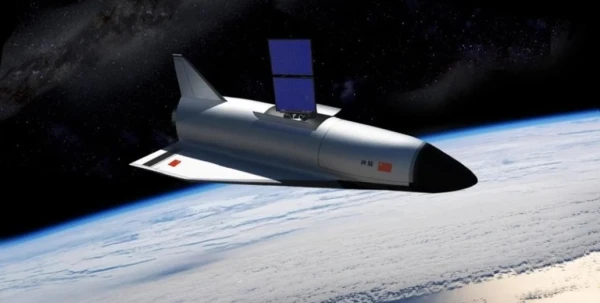
For the fourth time, the reusable spaceplane "Shenlong" has been launched into low Earth orbit. Experts do not know exactly what it is doing in space, but there are some clues.
The Chinese secret spaceplane "Shenlong" was launched into orbit on February 7 of this year, marking the beginning of its fourth mysterious mission. What exactly is it doing in orbit? Experts have their assumptions, writes Focus citing Space.
The Chinese government has revealed few details about the reusable unmanned spaceplane "Shenlong." It is known that it is currently in low Earth orbit, but at what altitude is unclear. Its fourth mission began on February 7, but how long "Shenlong" will remain in space is unknown. Its first mission started in September 2020 and lasted only two days, the second began in May 2023 and lasted 276 days, while the third mission started in September 2024 and ended after 266 days.
According to official statements from China, "Shenlong" is helping to test technologies that will pave the way for more convenient and accessible methods of space travel for peaceful uses of space in the future.
This explanation resembles what the American military provides for the missions of the secret spaceplane X-37B, which is believed to be broadly similar to "Shenlong." A high level of secrecy unites these two unmanned spacecraft: no one knows about the overwhelming majority of the technologies onboard.
The X-37B, owned by the U.S. Space Force, is 8.8 meters long and looks like a miniature version of the old NASA space shuttles. This spacecraft began its eighth mission in space in August 2025. It was first launched into orbit in 2010.
Although the American military insists that the X-37B is a testbed for new technologies, some experts believe it could be a space weapon. However, analysts from the non-profit organization Secure World Foundation (SWF) think otherwise. According to them, the X-37B has never approached any other known space object and generally orbits the Earth significantly lower than the overwhelming majority of operational satellites.
The X-37B is also not suitable for delivering space-to-ground class weapons due to its small cargo bay.
American analysts believe that "Shenlong," which is approximately the same size as the X-37B, is unlikely to be intended for delivering missile strikes from space. But unlike the X-37B, the Chinese spaceplane has performed approaches to other objects in space.
In each of its previous missions, "Shenlong" placed one or more objects into orbit. Experts from SWF say that the satellite launched into orbit during the first mission demonstrated data transmission capabilities, while the satellite launched during the second mission presumably demonstrated the ability for independent movement. Meanwhile, "Shenlong" performed numerous close-range maneuvers and capture/docking operations with the satellites it launched into orbit.
Analysts believe that such approach and docking operations may be a priority for the Chinese secret project "Shenlong." These operations in orbit could allow China to refuel, repair, and upgrade its own satellites and potentially observe or interfere with the operations of adversary spacecraft.
Therefore, some experts believe that "Shenlong" is testing technologies for countering satellites. It is difficult to say how justified this assumption is, given the secrecy of the project.














Leave a comment