
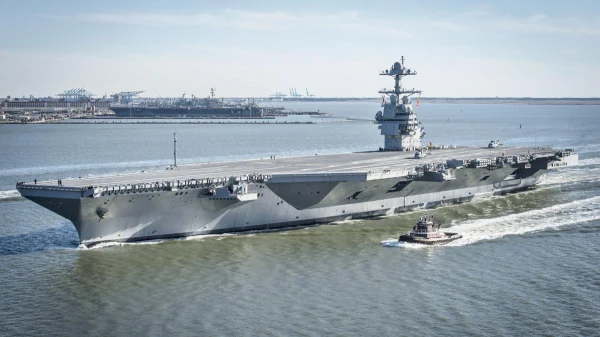
Modern aircraft carriers, particularly the American Ford class, impress with their scale and firepower. However, even these large vessels remain vulnerable to powerful storms. The publication SlashGear details how these giants cope with wind and waves in open sea.
The author of the material notes that protection begins long before encountering the elements. To support his opinion, he provides historical examples of the high price the fleet paid for ignoring the forces of nature.
"During World War II, Typhoon Cobra caused significant damage to the aircraft carriers and support ships of Admiral Halsey's Task Force 38 in the Philippines, damaging or destroying nearly 150 aircraft and resulting in the deaths of hundreds of sailors. In 1988, the first of the historic Midway-class aircraft carriers survived a 26-degree list during a typhoon in the Sea of Japan," the journalist stated.
Today, according to the observer, the U.S. Navy uses the most modern weather forecasting models. Specialized aerographers onboard and onshore provide accurate data, allowing for course adjustments in advance and avoiding the epicenters of storms.
Turning the Deck into a "Fortress"
The material details the process of preparing aircraft for severe pitching. It is noted that fighters are moved from the edges of the deck closer to its center, where the ship's motion amplitude is less. Each aircraft is secured at several points using heavy steel chains and special wheel chocks. Part of the air fleet is lowered into hangars, which are hermetically sealed with waterproof doors. This is a multi-level process where each step is clearly regulated.
The Art of Navigating in a Storm
According to the publication, the survival of the ship depends on the skill of the navigation team. The safety of the aircraft carrier directly depends on how level it stands in the water. Even a slight tilt can lead to disaster. To prevent the ship from rolling in the waves, the helmsmen direct it at a special angle to the water, while smart onboard systems automatically pump water in and out of tanks and deploy underwater stabilizers for balance. Although these methods are used on many large vessels, the risks are highest for aircraft carriers due to the enormous cost of the aircraft onboard.
Despite decades of refined procedures, the author acknowledges that incidents still occur. Even recent aircraft losses in 2025 were related not directly to storms but to technical malfunctions during sharp maneuvers. This only confirms the effectiveness of existing protocols for protection against the elements, which allow "floating airfields" to remain operational even in the harshest ocean conditions.









Leave a comment