
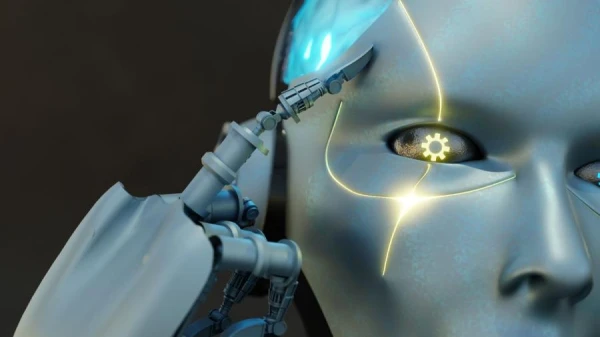
For company leaders, as explained in an interview with CNBC by former Citi Global Insights director Rob Garlick, the priority remains increasing business profitability, and a living employee made of flesh and blood is already capable of losing to robots on these criteria.
Artificial intelligence, in his opinion, will be capable of doing more and more, with decreasing costs, and therefore it will increasingly begin to replace humans as a labor resource.
In the next couple of decades, according to the expert, there will be more mobile robots on the planet than people of working age. If we also consider AI agents, this number of "artificial workers" will increase exponentially.
Along with autonomously operated vehicles, the number of various service robots is expected to reach 1.3 billion by 2035, according to Garlick. The number of robots using AI will exceed 4 billion by 2050.
With current labor costs in various economies around the world, replacing a human with a robot can already ensure quick payback. For example, a robot costing $15,000 with a labor cost of $41 per hour will break even in 3.8 weeks, while at a labor cost of $7.25 per hour, it will take 21.6 weeks to pay off.
Even a robot costing $35,000 can pay for itself in less than 9 weeks with labor costs of $41 per hour. With such figures, humans simply cannot compete, as noted by Garlick.
Bob Sternfels, managing partner at McKinsey & Company, expects that in his company, the number of actual employees and the AI agents replacing them will equalize in just 18 months. Currently, there are 20,000 AI agents for 40,000 employees in the company, whereas a year ago, their number did not exceed 3,000.
IMF Director Kristalina Georgieva stated last month that artificial intelligence is already hitting the labor market like a tsunami, and most countries and business representatives are simply not prepared for it.















Leave a comment