
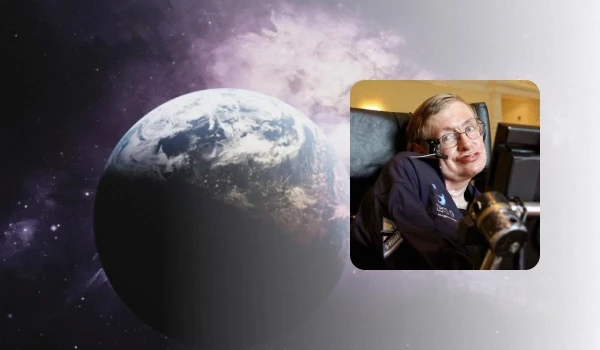
He was the first to present a cosmological theory that unified concepts from general relativity and quantum mechanics.
The renowned astrophysicist Stephen Hawking had doubts about whether humanity could survive the next thousand years.
"I don’t think the human race will survive the next thousand years, unless we spread into space," he once warned, claiming that life on Earth is too susceptible to disasters.
As reported by Ecoticias, these disasters refer to natural events that can cause climate changes.
In one interview, the theoretical physicist cautioned that "too many accidents can happen to life on one planet," and argued that humanity needs to reach the stars to reduce the risk of extinction. He repeated this concern for many years.
In particular, Hawking was troubled by issues such as nuclear war, uncontrolled climate change, artificially created pandemics, uncontrolled artificial intelligence, and rapid population growth.
All of these, the scientist considered threats that could paralyze civilization over the next thousand years.
"For him, space exploration was not just an adventure. It was long-term insurance," the publication noted.
Climate Change
Climatology helps explain why Hawking's words are so relevant today. According to the Intergovernmental Panel on Climate Change, by 2020 global warming had reached about 1.1 degrees Celsius. This additional heat manifests in everyday life as higher electricity bills during summer heat, floods, and crops affected by drought or late frosts.
At the same time, a biodiversity assessment supported by the UN found that about one million species of animals and plants are at risk of extinction, many within decades due to habitat loss, pollution, invasive species, and climate change.
The latest report from the UN Environment Program suggests that under current policies, the world will be heading towards warming of about 3 degrees this century, far exceeding safe temperature limits.
Space as an Insurance Option
Hawking believed that building permanent human settlements beyond Earth would be crucial. However, experts emphasize the simple reality that in the foreseeable future, any base on the Moon or Mars will house only small crews in harsh conditions, supplied from Earth and protected by technologies that may fail.
For everyone else, the only breathable air, arable soil, and drinking water will still be here on Earth.
"That’s why reducing emissions, expanding the use of renewable energy, protecting forests and oceans, and redesigning cities for cleaner transport are far more important than hoping for a quick way to salvation. A cooler planet and healthier ecosystems are the most practical 'insurance policy' we have," the publication stated.
Hawking's Forecast Today
The publication noted that in practical terms, Hawking's warning sounds less like a call to abandon Earth and more like a reminder that our smart technologies can either exacerbate risks or help us step back from the brink. This suggests that cooperation in climate, biodiversity, and public health is as important as the next major space mission.
"In most cases, our best survival strategy still begins with choices that keep the climate livable and the biosphere sustainable while we cautiously explore the world beyond our planet," the publication concluded.
Stephen William Hawking (January 8, 1942, Oxford – March 14, 2018, Cambridge) was a British theoretical physicist, cosmologist, astrophysicist, and author. He was the Director of Research at the Centre for Theoretical Cosmology at the University of Cambridge. He authored several scientific works, including a joint work with Roger Penrose on theorems regarding gravitational singularity in the framework of general relativity and the theoretical prediction of black holes emitting radiation, often referred to as Hawking radiation. Hawking was the first to present a cosmological theory that unified concepts from general relativity and quantum mechanics. He actively supported the many-worlds interpretation of quantum mechanics.
Hawking was an honorary member of the Royal Society of Arts, a lifetime member of the Pontifical Academy of Sciences, and was awarded the Presidential Medal of Freedom—the highest civilian award in the U.S. In 2002, as a result of a BBC poll of the "100 Greatest Britons of All Time," Hawking ranked 25th. He was the Lucasian Professor of Mathematics at the University of Cambridge from 1979 to 2009 and achieved commercial success through popular science works in which he discussed his own theories and cosmology in general. Hawking's book "A Brief History of Time" was on the bestseller list of the British edition of The Sunday Times for a record 237 weeks.
Hawking had a rare slow-progressing form of motor neuron disease (also known as amyotrophic lateral sclerosis or Lou Gehrig's disease), which gradually paralyzed him over decades. After losing his speech, Hawking was able to communicate via a speech synthesizer, initially using a hand switch and later using a cheek muscle. He died on March 14, 2018, at the age of 76.












Leave a comment