
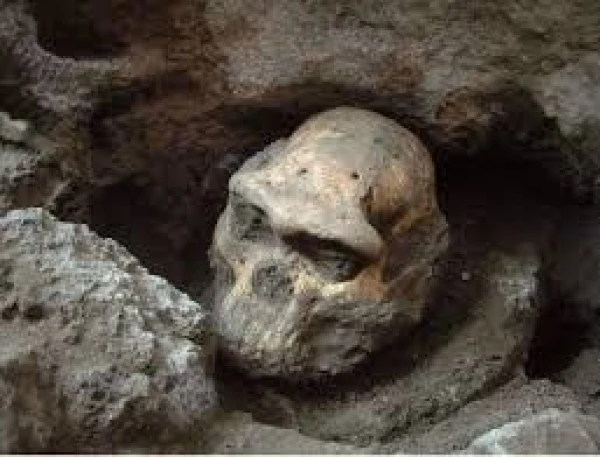
The occiput and vault of the skull had typical features of Homo erectus, but the face remained flat and short.
An international group of anthropologists has discovered that the expansion of humanity beyond Africa was initiated not by tall, big-headed athletes, as previously thought, but by populations with archaic appearances. A virtual reconstruction of the face of one of the oldest skulls from Ethiopia revealed that one and a half million years ago, alongside progressive forms of humans, there lived beings morphologically similar to the finds from the Georgian city of Dmanisi.
Paleontology had long relied on a linear scheme: primitive Homo habilis evolved into tall Homo erectus with large brains, who, due to their physical superiority, were able to populate Eurasia. Classic Kenyan finds, such as the skeleton of the "Turkana Boy" (who could have reached a height of 180 centimeters), supported this image. However, the discovery of the skull DAN5/P1 in Gona (Ethiopia) created a paradox. This adult individual had a brain volume of less than 600 cubic centimeters — smaller than that of modern chimpanzees — which contradicted the theory that migration required developed intelligence and a large body.
The authors of the study, published in the journal Nature Communications, reconstructed its face, found in the form of scattered fragments. The scientists scanned the fragments of the upper jaw and cheekbones using a micro-CT scanner, then digitally reassembled the skull in a digital environment using anatomical markers and mirror imaging of the preserved parts. The resulting 3D model was overlaid on a map of morphological data from dozens of other fossil hominids.
The analysis revealed the mosaic nature of the find. The occiput and vault of the skull had typical features of Homo erectus, but the face remained flat and short, and the teeth were unexpectedly large, like those of the more ancient habilines. The most important result was that the closest relatives of the Ethiopian "dwarf" turned out to be not its tall neighbors from Kenya, but the people from Dmanisi (Georgia) — the oldest known inhabitants of Eurasia from the ancestors of modern humans.
The results of the study prove that the evolution of bipedal humans was not a linear process of improving parameters. One and a half million years ago, different groups of people coexisted in East Africa: some rapidly increased in size, while others retained their miniaturization and archaic traits. The data indicate that it was the second, more primitive group that became the first wave of migrants leaving the continent.
















Leave a comment