
During the tests, the air intake delivered parameters even above the standards.
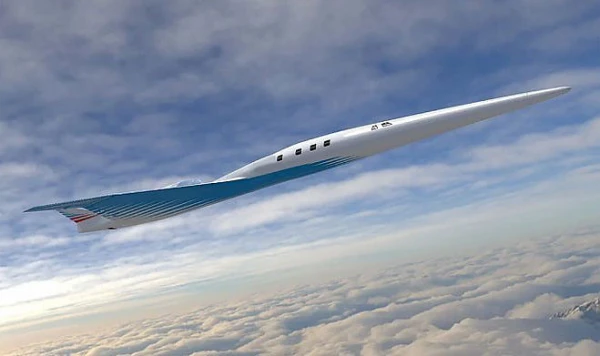
Engineers at the Central Aerohydrodynamic Institute (TsAGI) continue work on the Russian supersonic aircraft "Strizh," which will be equipped with RD-93MS turbojet engines. Recently, a series of comprehensive tests of its model was conducted.
In particular, a promising scheme with the placement of engines on the upper part of the fuselage was studied for the first time, which, according to calculations, will ensure a significant reduction in the level of sonic boom, one of the key challenges in creating supersonic aircraft for civil use.
Initially, tests of the air intakes and flat-shaped jet nozzles with an oblique cut were conducted in the wind tunnel. During the tests, the air intake delivered parameters even above the standards, while the thrust losses for this type of nozzle were within acceptable limits for the demonstrator.
After that, at the "ODK-Klimov" site, testing of the modified RD-93MS engine, which has a "noise reduction system" for takeoff modes developed by TsAGI specialists and is equipped with a flat nozzle, was undertaken. Its thrust fully met the design requirements.
At the next stage of the "Strizh" program, a full-fledged technology demonstrator will be created, with a takeoff weight of about 16 tons, two engines, and a fuselage made of composite materials. It will have a "closed" cockpit, implying no glazing and control via external cameras. The demonstrator is expected to make its first flight in 2029.














Leave a comment