
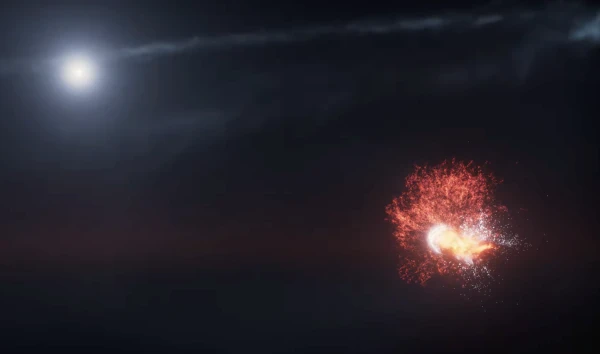
Scientists initially thought they had discovered a new planet near the star Fomalhaut. But it turned out to be a collision of two objects that lead to the formation of planets, reports Focus.
Astronomers witnessed a stunning spectacle around the young star Fomalhaut. It turns out that two collisions between large objects in another star system have been detected for the first time. Observing such collisions can provide astronomers with insights into the conditions under which Earth and other planets formed 4.6 billion years ago. The study is published in the journal Science, reports Space.
The star Fomalhaut is located 25 light-years away from us and is estimated to be 440 million years old. This is a young star around which a planetary system is forming. In comparison, the Sun has existed for 4.6 billion years.
According to astronomers, young star systems like Fomalhaut are sites of powerful collisions, where cosmic rocks, asteroids, and large planetesimals collide with each other. Often, the collision of planetesimals leads to the formation of planets and their satellites.
In 2008, astronomers discovered an unexplained bright object near the star Fomalhaut. Initially, they assumed it was a planet, named Fomalhaut b. However, a few years ago, astronomers found that it was not a planet, but a cloud of debris from a collision of planetesimals in another star system. Now, astronomers have detected another similar collision in data from the Hubble Space Telescope, along with the dust cloud left behind. Thus, astronomers have for the first time obtained direct images of such events occurring in another star system. The first dust cloud was named Fomalhaut cs1, and the second one Fomalhaut cs2.
According to scientists, they witnessed two collisions of planetesimals and the formation of dust clouds that began to reflect the light of the star. In a sense, this is an opportunity for scientists to glimpse into the past of the Solar System, when planets were forming over 4 billion years ago. Something similar is happening in the Fomalhaut system.
Although astronomers did not see the collisions of planetesimals directly, they did record the aftermath of these events.
Calculations by scientists showed that the two collisions involved cosmic rocks approximately 60 kilometers in size each. This is nearly four times larger than the asteroid that struck Earth 66 million years ago and wiped out the dinosaurs.
According to scientists' estimates, there are about 300 million objects around the star Fomalhaut similar to those that caused the collisions cs1 and cs2.
The authors of the study state that the Fomalhaut system represents a natural laboratory for studying the behavior of planetesimals during collisions, which in turn allows us to learn about their composition and how they formed.









Leave a comment